

Butterfly Flowers


Can you find two butterflies to go on each flower so that the numbers on each pair of butterflies adds to the number on their flower?
Problem
Butterfly Flowers printable sheet
Look at these butterflies and flowers. All of them have a number.
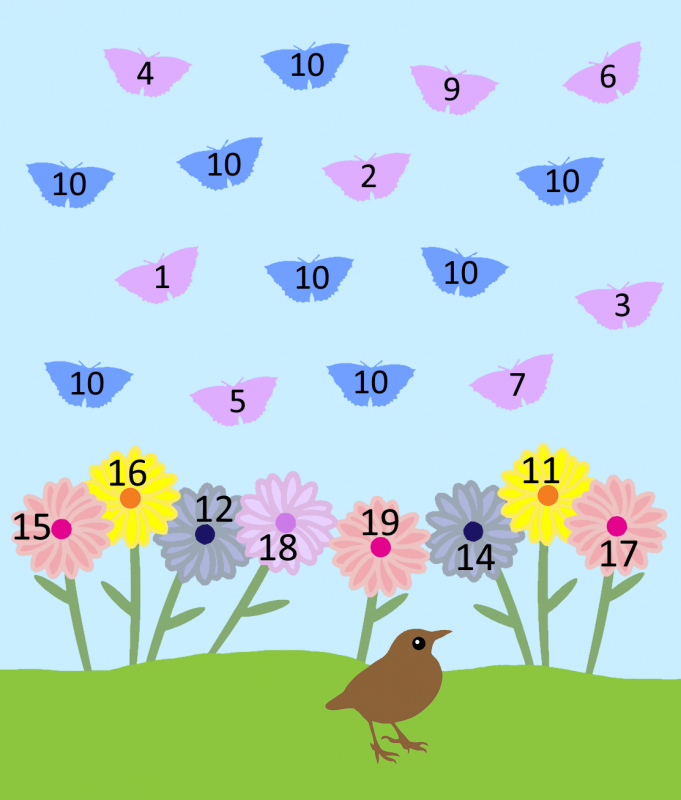
Can you find two butterflies to go on each flower so that the butterfly numbers add to the flower number?
Which pair of butterflies has no flower to go to? Why?
Which flower cannot have a pair of butterflies on it? Why?
Click below to see how three children started this task:
Zac said:
I noticed there were eight butterflies which all had the number 10 on them, so I put one on each flower.
Mona said:
I picked two butterflies and added their numbers together.
Anita said:
I noticed that if I added two blue butterflies together I didn't get a flower total.
Did you start the problem in the same way as any of these children?
What do you think about each method?
Getting Started
You could use these cards to move around and group together.
Student Solutions
We had these solutions sent in to this task, which are worth looking at carefully.
Mishika from Bal Bharati Public School, India sent in the following:
First I have joined flowers with the butterflies.
I have added 10 with 5 to make 15
Then added 10 with 6 to make 16
Then added 10 with 2 to make 12
Then added 10 with 9 to make 19
Then added 10 with 4 to make 14
Then added 10 with 1 to make 11
Last I added 10 with 7 to make 17
But I found that there is no pair for the flower 18.
Anvi from James Allen's Prep School wrote:
There are 8 flowers, all numbered between 10 and 20.
There are 16 butterflies, 8 of which are numbered 10.
First I ordered all pairs, each having a number 10 butterfly.
Next, I added the pair.
I then placed the sum of each pair on the corresponding flower.
There was no flower with number 13, hence butterflies 10 and 3 cannot go in any flower.
No pair added to 18, so there can be no butterflies on flower 18.
Macy-May from All Saints C of E Primary School wrote:
So I made all the numbers up but not 18 because there was no 8 and there was only 3 left over:
10+5=15;
10+6=16;
10+2=12;
10+____=18;
10+9=19;
10+4=14;
10+1=11;
10+7=17
The only flower that did not have a butterfly was 18.
From the Burke Ward Public School in Australia we had the following:
Students worked in small groups for this investigation. Initially, each group noticed something different which they shared with the whole class:
- the flowers were different colours (two flowers have the same colour and they followed each other in a counting sequence)
- each flower had a two-digit number (11-19)
- nine flowers
- each of the numbers on the flowers had a 1 in the tens column (eg. 13 is 1 ten and 3 more)
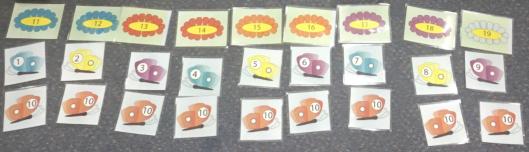
After listening to what each group had noticed students started investigating which butterflies could go together to equal a total on a flower. Groups discovered they needed a butterfly with 10 on it beside each flower (for the value of the 1 in the tens position) and a one-digit butterfly that
added to it to make the total of the flower (e.g.10+3=13).
They changed the tasks slightly and produced this result:
Thank you for these.
Teachers' Resources
Butterfly Flowers
Butterfly Flowers printable sheet
Look at these butterflies and flowers. All of them have a number.
Can you find two butterflies to go on each flower so that the butterfly numbers add to the flower number?
Which pair of butterflies has no flower to go to? Why?
Which flower cannot have a pair of butterflies on it? Why?
Click below to see how three children started this task:
Zac said:
I noticed there were eight butterflies which all had the number 10 on them, so I put one on each flower.
Mona said:
I picked two butterflies and added their numbers together.
Anita said:
I noticed that if I added two blue butterflies together I didn't get a flower total.
Did you start the problem in the same way as any of these children?
What do you think about each method?
Using NRICH Tasks Richly describes ways in which teachers and learners can work with NRICH tasks in the classroom.
Why do this problem?
This problem addresses a difficulty that many children experience with the numbers from ten to twenty. The 'teens' often cause more trouble than other decades up to 100 in English because of the irregularity of the language used. By focusing on creating the numbers from 11 to 19 using 10 and adding a single digit number, the problem gives an opportunity to practise building these numbers from one ten and different numbers of ones (the reverse of partitioning using place value).
By including three different children's starting points, the aim is to encourage learners to be curious about multiple approaches to a task. By reflecting on different ways of solving the problem and talking about them, learners can begin to appreciate the problem-solving journey and not just the answer.
Possible approach
Show the image of the butterflies and flowers to the group and invite children to think about what they see. Give them YOYO time (You On Your Own) before suggesting they talk to a partner. Gather suggestions from the whole group, making sure all comments are valued, even if they appear to be non-mathematical in nature! Encourage other learners to comment on or question their peers' suggestions so that everyone feels involved.
Once you feel you have established enough information, pose the question orally: "Can you find two butterflies to go on each flower so that the butterfly numbers add to the flower number?". Give children time to work on the task in pairs. Some butterfly and flower cards could be printed and laminated to be used by children - this set contains more numbers than are used in the task so you can choose some to leave out as needed. (They can also be useful as a set of cards for matching activities more generally.)
When everyone has found at least a few butterfly and flower groups, draw the class together and explain that you're now going to focus on how they have approached the problem. (You might like to reassure them that there will be more time to complete the task later.) It might be that you can draw on the methods that different pairs of children in the class have used, or you could share the three alternative approaches described in the problem as Zac's, Mona's and Anita's methods. Invite everyone to look at each method and understand it, before facilitating a general discussion about the different approaches. Did any pair use one of these methods? What do they like about each? What do they not like?
Key questions
What can you say about the picture?
How might you start?
What do you get if you choose two butterflies and add them together? What could you do now?
Possible extension
The cards could be used to make other pairs or sets of numbers that total to different target numbers. Multiple sets of the cards will increase the number of possible solutions.
Possible support
When children are counting together make sure that the 'teens' are well differentiated from the 'tens', for example, that 'sixteen' is well differentiated from 'sixty'.