

Zias and Zepts


On the planet Vuv there are two sorts of creatures. The Zias have 3 legs and the Zepts have 7 legs. The great planetary explorer Nico counted 52 legs. How many Zias and how many Zepts were there?
Problem
Zias and Zepts printable sheet
On the planet Vuv there are two sorts of creatures. The Zias have 3 legs and the Zepts have 7 legs.

The great planetary explorer Nico, who first discovered the planet, saw a crowd of Zias and Zepts. He managed to see that there was more than one of each kind of creature before they saw him. Suddenly they all rolled over onto their backs and put their legs in the air.
He counted 52 legs. How many Zias and how many Zepts were there?
Do you think there are any different answers?
Getting Started
Drawing some pictures or using sticks/counters for legs might help.
Do you have any idea approximately how many Zias and Zepts there might be to make $52$ legs?
You could try choosing a certain number of Zias and a certain number of Zepts, then count their legs. Do you need more legs or fewer to have a total of $52$?
Student Solutions
We had a good number of solutions sent in for this challenge, here are a few to think about.
Jack from Whangaparaoa School in New Zealand
3 x 1 = 3 52 - 3 = 49 divided by 7 = 7
3 x 8 = 24 52 - 24 = 28 divided by 7 = 4
3 x 15 = 45 52 - 45 = 7 divided by 7 = 1
Shivoham from Robin Hood Junior School sent in the following:
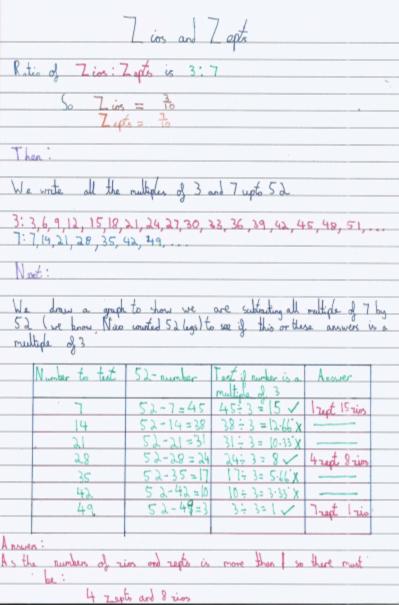
From Hamilton South Public in Australia we had a few submitted solutions:
Henry:
Yes there are different ways to make 52, what I did was I had 7 Zepts and 1 Zias which makes 52 legs. But you can also make 52 legs with 4 x 7 Zepts = 28 legs and 3 x 8 = 24 so 28 + 24 = 52. So this shows there is more than 1 way to answer this question.
Caylum:
52 Legs would make 4 Zepts and 8 Zias
Finn:
In solving this problem of zepts and zias, there can be numerous answers to this problem. Some of the solutions include- 1 lot of zias and 7 lots of zeptsI worked this out by the olution- 52/7= 7 with 3 left over there for on of the solutions is 1 lot of zias and 7 lots of Zepts. Another solution I came up with was- 15 lots of zias and 1 lot of zepts I worked this solution out by swapping the numbers around from solution one- 52/3=15 with 7 left over there for another one of the solutions is 15 lots of zias and 1 lot of zepts. As you can see there are more than one answer I have demonstrated only one though.
Matilda.
I know my 3 times table found that 3 times 15 = 45 and 45 is 7 less that 52.
7 Times 7 is 49 which is 3 less than 52.
Jett :
I added up the legs by doing the Zepts legs and the Zias legs at the same time so
7+3=10 10+3+7=20 20+7=3=30 30+7+3=40 40+3+3+3+3=52
My other way was 7+7+7+7+7+7+7=49, 49+3=52
First answer 8 Zias 4 Zepts.
Second answer 1 Zias 7 Zepts. So there are 2 answers to the Zias and Zepts question.
Advika from Wimbledon Chase Primary School in England
There are 4 Zepts and 8 Zias
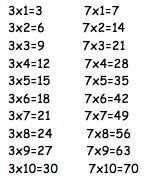
At first I tried to do it in ratio but it didn't work.I would write out the timetables of three and seven and then find out numbers that give a sum of fifty-two. Ratio does not work because (seven is to three )-the ratio- are not equal in one portion.My words may be rather. You could also approximate fifty two and use times tables to help you work
the main answer out. I could not find out any corresponding ways to get fifty two and would be grateful to get another answer that doesn't match mine. Below,I have uploaded a file that you may want to consider seeing as it should help you if you get stuck.I hope it is of help to you. Please consider my working out as I could not think of any other way to
come across the answer and would be happy to come across the method if
there is any. I hope this has come to use of you if any use.
As a Ratio it can't work 7:3 is the ratio for Zepts to Zias. When you add them together it equals to 10 and 52 divided by 10 equals (5.2).Th is method does not work because each portion does not equal the same .This is because of the fact that Zepts equal to seven and Zias equals to three.
Amaan from Christ Church School England wrote:
7x4=28 4 Zepts - 3x8=24 8 Zias
I got this answer by trying to go up systematically in the 7 times table. First of I tried finding out how many Zias there were.Firstly,I took away 14 away from 52 because of the description in the clue. The answer to this sum was 38.From the answer of 38 I tried dividing 38 from 3.But there was no full answer. Next I tried 21,52-21=31. So once again my answer was not in the 3 times table. The next number in the 7 times table was 28. So once again took took my answer 28 away from 52.52-28=24.I then found out 8x3=24.So that was the answer to how many Zias there were and because 28 is the answer to 7x4 that told me the answer to how many Zepts there were.
Anaya from GEMS Willington Academy-AlKhail in the UAE:
As mentioned one zias has 3 legs and one zepts has 7 legs and the scientist found total of 52 legs. We need to find the number of zias and zepts in the planet.
HERE IS THE SOLUTION
1 Zias = 3 legs
8 zias have = 3 x 8 = 24 legs
1 zepts = 7 legs
4 zepts have = 7x4=28 legs
So total no of legs =24+28=52
So the answer is There are 8 NUMBER of zias and 4 NUMBER of zepts in the planet.
Great! You have worked hard on getting solutions and there are some good explanations as to how you went about finding solutions.
Teachers' Resources
Using NRICH Tasks Richly describes ways in which teachers and learners can work with NRICH tasks in the classroom.
Why do this problem?
This problem focuses on numbers that are multiples of 3 and 7 and offers a motivating context in which to develop instant recall of them. It also provides an opportunity for learners to discuss alternative strategies and to consider the merits of each.
Possible approach
Children enjoy considering strange forms of life in imaginary planets and these weird creatures with odd numbers of legs should appeal to them. You could begin by telling the story in more detail and introducing a simpler version of the problem, for example, if Nico saw 6 legs what creatures might he have seen? And how about 14 legs? Or 13 legs? Ask them to work in pairs, perhaps on mini-whiteboards, to think about these first challenges. As they work, observe different ways of recording and thinking about the problem which you can share with the whole group.
At the end of the session learners could share not only their solutions but also their methods. Some may have used a trial and improvement approach, either with the materials provided or using pictures; some may have written lists of multiples of 3 and 7 in a very systematic way and then made totals. Children could consider whether some strategies were more effective than others, although of course a strategy that is effective for one child may be very confusing for another. Having the freedom to approach this problem in any way is key here, but in talking to others, some pupils might change the way they work, which is interesting in itself.
Key questions
Possible extension
Learners could investigate other possible numbers of legs of a group of Zias and Zepts. Perhaps some can be done in more than one way. How many ways can be found for each target number? The investigations can go on and on!
Possible support
Starting with lower totals and using practical equipment to support them will help some children. They may like to write down all the multiples of 3 and 7 as an aid. Some children might benefit from trying the Starfish Spotting problem first which involves just multiples of 2 and 5, and lower totals.