

What's a Group?

 2 out of 3
Explore the properties of some groups such as: The set of all real numbers excluding -1 together with the operation x*y = xy + x + y. Find the identity and the inverse of the element x.
Problem
This problem is about infinite groups. We first meet groups when we do simple number work and they are useful in much more general applications. To use groups in higher mathematics we need a precise definition.
A group is a set of elements together with a binary operation and four defining properies (see the notes). Some groups are commutative (Abelian) and other groups are not.
(a) Convince yourself that the set of integers with the operation of addition satisfies the four given conditions and so forms a group. Why does the set of natural numbers (positive integers) with the operation of subtraction not form a group?
(b) Convince yourself that the set of positive rational numbers with the operation of multiplication forms a group. Why does the set of positive rational numbers with the operation of division not form a group?
(c) Why does the set of positive integers with the operation of multiplication not form a group?
(d) Why does the set of positive even integers with the operation of multiplication not form a group?
(e) The set of integers with the operation * defined such that $m*n = m + n + 1$ is a group. Find the identity element and the inverse of the element $m$.
(f) The set of integers with the operation * defined by $m*n = m + (-1)^m n $ is a group. Find the identity element and the inverse of the element $m$.
(g) The set of all real numbers excluding only the number -1 together with the operation $x*y = xy + x + y$ is a group. Find the identity and the inverse of the element $x$.
To read more about groups and properties of groups, which may help you with this problem, see Small Groups. The article is about finite groups.
Student Solutions
We received a good international response to this classic problem: Patrick, from Woodbridge School and Aurimas from Chatham Grammar School for Boys in England; Neil from Kensal Park in Canada; Jungsun and Junho from Nanjing International School in China.
Each adopted a slightly different way of viewing the problem and it might be interesting to compare approaches: for this reason we include all correct responses in full!
Parts E, F and G caused the most trouble with a few incorrect solutions concerning identities and inverses; overall, however, a full answer was constructed by all respondents collectively. Well done!
Solutions are as follows:
Patrick adopted a classic minimalist approach of a mathematician by realising that a single counterexample was sufficient to show that something was not a group. He uses notation of != to mean 'not equal to' and '==' to mean 'is equivalent to. Of course, this hides any thought which went into creating these counterexamples!
Part a) The set of natural numbers with subtraction is not a group, since $3-7 =-4$ which is not in the set, so the property of closure is not satisfied.
Part b) The set of positive rationals with division is not a group, since taking $a=1, b=2, c=3$ we have $(1/2)/3 = 1/6 != 1/(2/3) = 3/2$, so the property of associativity is not satisfied.
Part c) The set of natural numbers with multiplication is not a group, since there is no inverse of 2: The identity is $1$, so $2*x = x*2 = 1$, where $x$ is the inverse. $2x = 1$ implies $x = 1/2$ which is not in the set of natural numbers.
Part d) The set of positive even integers with multiplication is not a group since the identity does not exist: there is no even number by which 4 can be multiplied to give $4$: $4x = 4$ $x = 1$ which is not a member of the even natural numbers.
Part e) $m*n = m+n+1$; find the identity and inverse of m. The identity is $e$ such that $m*e == e*m == m$; $m*e == m+e+1 == e*m$ by definition, so we need $m+e+1 == m$ $e+1 == 0$ $e == -1$
Aurimas followed a similar style to Patrick:
Part a:The given set with an operation of subtraction does not satisfy the first condition( did not even consider the other ones, as Closure is not satisfied). Let $a = 3$ and $b = 5$, but then $3-5=-2$ which is not a natural number, and is not in the group, therefore it is not a group
Part b: This set does not satisfy ASSOCIATIVITY. Let $a = 2 b = 4 c = 6$, then $(a*b)*c = (b*c)*a ( 48 = 48)$, but when division comes in, this condition is not satisfied, eg : $((a/b))/c =( 1/12)$ is not equal to $((b/c))/a =( 1/3)$ and therefore it is not a group.
Neil realised for part G that an standard arithmetical equation could be solved to find identities and inverses:
Part g: To find the identity, we set up an equation: $xy+x+y=x$. Subracting $x$ from both sides, we get $xy+y=0$. Therefore, $y(x+1)=0$ or $y=0$. Hence, the identity is $0$. To find $x$'s inverse, we set up another equation: $xy+x+y=0$. Then, $y(x+1)=-x$ or $y=-x/(x+1)$. Therefore, $x$'s inverse is $-x/(x+1)$.
Jungsun adopted a more expansive approach in which ways to alter the structure of the groups as given so that the various axioms might be satisfied were also considered along with counterexamples. Jungsun also looked at which axioms did work and why that was the case. We really liked this: if something doesn't quite work mathematicians often work very hard to understand how something MIGHT be made to work. Mathematics is as much about exploration of mathematical structures as it is about answering specific questions. Well done!
PART a) For the first property, closure, for all positive integers $a$ and $b$ in the group, the element of $a-b$ should be also in the group. However, if $a$ is smaller than $b$, the value of $a-b$ is negative and doesn't satisfy the property. On the other hand, for all integers $a$ and $b$, the element of $a+b$ is always an integer which satisfies the property.
For the second property, associativity, for all positive integers, the element of $(a - b) - c$ should equal to $a - (b - c)$. However, if $a=1, b=3$, and $c=7$, ($a-b)-c =(1-3)-7=-9$ while $a-(b-c) =1-(3-7)=5$ which doesn't qualify the property. But for all integers, $(a + b) + c = a + (b + c)$ definitely works.
For the third property, identity, for all positive integers $a$ and $e$, $a - e = e - a = a$ should work. To satisfy it, $e$ should be $0$, but since it is not a positive integer, the property is not fulfilled. But for all integers, since $0$ is included in an integer group, $a + e = e + a = a$ works.
For the fourth property, inverses, for all positive integers $a$ and $a'$, $a - a' = a' - a = e$ should work. However, since the third property is not satisfied, there is no e, so the fourth one can't be worked. For all integers, however, there is the value of $e$ and $a + a' = a' + a =0$ works.
PART b) For the first property, closure, for all positive rational numbers $a$ and $b$ in the group, the element of $a/b$ should be also in the group. However, if $a = 1$ and $b = 3$, the value of $a/b$ is not a rational number anymore, so it doesn't satisfy the property. On the other hand, for all positive rational numbers $a$ and $b$, the element of $a*b$ is always a positive rational number which satisfies the property.
For the second property, associativity, for all positive rational numbers, the element of $(a/b)/c$ should equal to $a/(b/c)$. However, if $a = 1, b = 2$, and $c = 10$, $(a/b)/c = (1/2)/10 = 0.05$ while $a/(b/c) = 1/(2/10) =5$ which doesn't qualify the property. But for all positive rational numbers, $(a*b)*c = a*(b*c)$ definitely works.
For the third property, identity, for all positive rational numbers $a$ and $e$, $a/e =e/a = a$ should work. However, there is no way to satisfy it. But for all positive rational numbers, $a*e = e*a = a$ works when $e=1$.
For the fourth property, inverses, both multiplication and division work. For division, when $a$ equals to $a'$ and for multiplication, when a equals to $1/a'$.
PART c) For the first property, $a*b$ works for all positive integers.
For the second property, $(a*b)*c = a*(b*c)$ also works for all positive integers.
For the third property, identity, for all positive integers $a$ and $e$, $a*e =e*a = a$ works when $e=1$.
However, for the fourth property, inverses, for all positive integers $a$ and $a'$, $a*a' = a'*a =1$ should work. It is satisfied when $a$ equals to $1/a'$ , but then, $1/a'$ is not a positive integer anymore.
So the set of positive integers with the operation of multiplication doesn't form a group.
PART d) For the first property, $a*b$ works for all positive even integers. For the second property, $(a*b)*c = a*(b*c)$ also works for all positive even integers.
For the third property, identity, for all positive even integers $a$ and $e$, $a*e = e*a = a$ works when $e=1$, but since $1$ is not a positive even integer, it doesn't work.
Since the third property doesn't work, the fourth one doesn't work as well.
So the set of positive even integers with the operation of multiplication doesn't form a group.
PART f) For all integers, $m*n = m+(-1)mn$ works. For the identity element, $m*e =e*m = m+(-1)me = m$ and $e = 0$. For the inverse element, $m*m' = m'*m = e$ which is $0$. So $m+(-1)mm'$ should equal to $0$. When m is an odd integer, $m'=m$ while $m$ is an even integer, $m'=-m$. In brief, the identity element is $0$ and when $m$ is an odd integer, the inverse element of element $m$ is $m$, while it is an even integer, that of element $m$ is $-m$.
PART g) For all real numbers excluding the number $-1$, $x*y=xy+x+y$ works. For the identity element, $x*e=e*x=xe+x+e=x$. So $xe+e=0$. To satisfy $e(x+1)=0$ for all real numbers $x$, e should be $0$. For the inverse element of element $x$, $x*x'=x'*x=e$ which is $0$. So $xx'+x+x'=0$ and $x'(x+1)=-x$. As a result, $x'=(-x)/(x+1)$. In brief, the identity element is $0$ and the inverse element of element $x$ is $(-x)/(x+1)$.
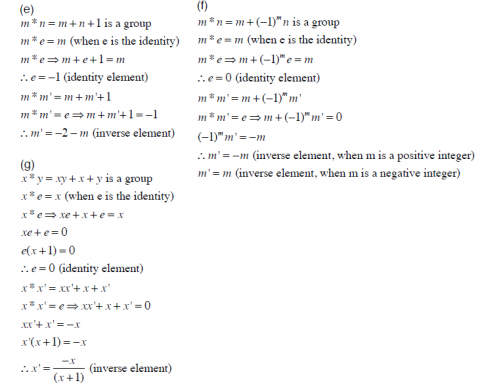
Junho laid out the solution to parts e, f and g very clearly:
This problem was also published several years ago: the solutions received the first time around are shown here:
Good solutions to 'What's A Group' came from Curt from Reigate College and Andrei from Tudor Vianu National College, Bucharest, Romania.
(a) The set of natural numbers with the operation of subtraction does not form a group because the following properties of a group are not present:
Closure: If $a$ and $b$ are natural numbers and $a< b$, then $(a - b)$ is not a natural number.
Associativity: $(a - b) - c \neq a - (b - c)$, e.g. $(20-12)-5\neq 20 - (12-5)$.
Identity: 0 is an integer, and $a + 0 = 0 + a = a$. True (So the identity $e = 0$)
Inverses: $a + (-a) = (-a) + a = 0$. If $a$ is a natural number, $(-a)$ is not a natural number.
(Andrei)
(b) Rational numbers with multiplication A rational number, by definition is expressible as $m/n$ where $m, n $ are integers and $n\neq 0$. With the operation of multiplication, the following occurs: $m/n * t/y = mt/ny$. Once again, both the numerator and denominator are integers (also $n, y \neq 0$), hence closure is achieved.
When one investigates division, the following may occur. Let t=0 (it is a numerator so this integer is allowed) $$(m/n)/(t/y) = m/n * y/t = (my)/(nt).$$ But now the denominator is equal to 0. Any real number divided by 0 is not defined within the set of rational numbers. Therefore, condition (1) is contravened; closure is not achieved.
Also division is not associative e.g. $(100/50)/5 \neq 100/(50/5).$
(Curt)
(c) Positive integers with multiplication I check all the properties of the groups for the set of positive integers with the operation of multiplication:
Closure: If $a$ and $b$ are positive integers, then $a * b$ is also a positive integer. True.
Associativity: $(a * b) * c = a * (b * c)$ for all $a, b, c$ in the set. True.
Identity: 1 is a positive integer, and $a * 1 = 1 * a = a$. True (So the identity e = 1).\\ Inverses: $a * (1/a) = (1/a) * a = 1$. But $1/a$ is not always an integer.
So, the set of positive integers with the operation of multiplication does not form a group as it does not contain inverse elements.
(Andrei)
(d) The set of all positive even integers with the operation of multiplication would not form a group because this set does not contain inverses. But it is noted that no identity exists in this set. For any real number, the identity element of multiplication is 1. But 1 is not an even integer, and therefore not a member of the set of all even integers. This contravenes condition (3).
(Curt)
(e) The set of integers with the operation $*$ defined such that $m*n = m + n + 1$ is a group. The identity $e$, is defined as being an element such that $m*e= m$ or (as all the operations that make up $*$ are not affected by order) $e*m = m$. Therefore $m*e = m = m + e + 1$ which implies $e + 1 = 0$ and so $e = -1$.
The inverse element, $m^{-1}$, has the property that $m*m^{-1} = e = -1 = m + m^{-1} + 1$ an so $m^{-1}$, the inverse of $m$, is given by $m^{-1}= -(m+2).$
(Curt
(f) The set of integers with the operation $*$ defined by $m*n = m + (-1)^m n $ is a group with the following properties:
Closure: If $m$ and $n$ are integers, then $m * n$ is also an integer. True: $m*n=m + n$ when $m$ is even and $m - n$ when $m$ is odd.
Associativity: $(m * n) * p = m * (n * p)$. True.
Identity: $m *e = m + (-1)^m e = m$ for all integer $m$ implies $e = 0$ and also $0 * m = 0 + (-1)^0 m = m$, so the identity element is 0.
Inverses. One must work separately for even and odd elements. If $m$ is even ($m =2p$ where $p$ is an integer) then $m * m^{-1} = 0$ implies $ m + m^{-1} = 0$ and so $m^{-1} = -m.$ Similarly $-m * m = 0$ which verifies that the inverse is $-m$. If $m$ is odd then the inverse of $m$ is $m$.
The inverse of $m$ is given for both cases by $m^{-1} = (-1)^{m+1}m$.
(Andrei)
(g) The set of all real numbers excluding only the number -1 together with the operation $x*y = xy + x + y$ is a group.
The inverse $e$ is such that $x*e= x = xe + x + e$ and so $xe = -e$. Therefore $e=0$ is the identity.
If $x*x^{-1} = 0 = xx^{-1} + x + x^{-1} = 0$ then $ x^{-1}(x+1) = -x$ and so the inverse of $x$ is given by $x^{-1} = -x/(x+1)$ (hence $x\neq -1$, or else $x^{-1}$ is not a real number, which would contravene the properties of the group)
(Curt)
Teachers' Resources
A group is a set of elements together with a binary operation (which we denote here by $*$) with the following properties:
- CLOSURE For all elements $a$ and $b$ in the group, the element $a*b$ is also in the group.
- ASSOCIATIVITY If $a, b$ and $c$ are in the group then $(a*b)*c = a*(b*c)$.
- IDENTITY The group contains an element $e$, called the identity, such that if $a$ is in the group then $a*e = e*a = a$.
- INVERSES If $a$ is an element in the group then there is also an element in the group $a'$, called the inverse of $a$, such that $a*a' = a'*a = e$.
Some groups, which are called COMMUTATIVE or ABELIAN, have the property that, for all pairs of elements in the group, $a*b=b*a$.