

Picturing Pythagorean Triples
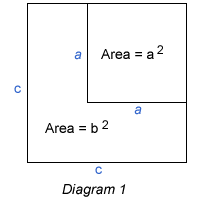
Somewhat surprisingly every Pythagorean triple $( a, b, c)$, where $a, b$ and $c$ are positive integers and $a^2+b^2 = c^2$, can be illustrated by this diagram, in which the L shaped region has area $b^2$, and the areas of the larger and smaller squares are $c^2$ and $a^2$.
With this clue you can find some triples for yourself right away. With an L strip of width 1 unit you get the whole class of Pythagorean triples with $a$ and $c$ as consecutive integers, that is $c = a+1.$ | Image
|
Image
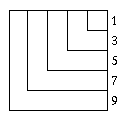
Diagram 2 | This diagram (extended as far as required) illustrates the fact that, for all $n$, the sum of the first $n$ odd numbers gives $n^2$. As we can see from the diagram to the left: \begin{eqnarray}1+3&=&2^2&=&4 \\ 1+3+5 &=& 3^2 &=& 9 \\ 1+3 +5 + 7 &=& 4^2 &=& 16 \\ 1+3+5+7+9 &=& 5^2 &=& 25 \end{eqnarray} |
Image
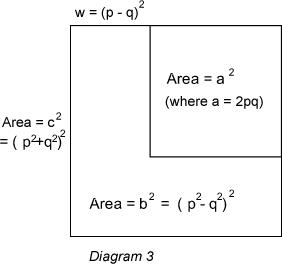
| To find other triples with L strips of different widths try this for yourself:
For example, taking $p= 5$ and $q= 2$, the inner square has dimensions $20$ by $20$ and the outer square has dimensions $29$ by $29$, the width of the L strip is $9$, and the area of the L strip is $(25-4)^2=21^2$, giving the Pythagorean triple $(20, 21, 29)$.
|
We shall concentrate on finding all the triples where $a, b$ and $c$ have no common factor. If $p$ and $q$ have a common factor, or if $p$ and $q$ are both odd, then $a, b$ and $c$ will have a common factor.
We only need the cases where one of $p$ and $q$ is even and the other is odd. In such cases the width of the L strip $= c-a=(p-q)^2$ is always an odd square.
The table below (extended in the obvious way) shows all the 'primitive' Pythagorean triples, and some non-primitive triples as well.
| Pythagorean Triples | $c-b=1^2$ ($p=q+1$) | $c-b=3^2$ ($p=q+3$) | $c-b=5^2$ ($p=q+5$) | $c-b=7^2$ ($p=q+7$) | $c-b=9^2$ ($p=q+9$) |
$c-a=2 \times 1^2$ $(q=1)$ | 3, 4, 5 | 15, 8, 17 | 35, 12, 37 | 63, 16, 65 | 99, 20, 101
|
$c-a=2 \times 2^2$ $(q=2)$ | 5, 12, 13 | 21, 20, 29 | 45, 28, 53 | 77, 36, 85 | 117, 44, 125 |
$c-a=2 \times 3^2$ $ (q=3)$ | 7, 24, 25 | 27, 36, 45 | 55, 48, 73 | 91, 60, 109 | 135, 72, 153 |
$c-a=2 \times 4^2$ $(q=4)$ | 9, 40, 41 | 33, 56, 65 | 65, 72, 97 | 105, 88, 137 | 153, 104, 185 |
$c-a=2 \times 5^2$ $(q=5)$ | 11, 60, 61 | 39, 80, 89 | 75, 100, 125 | 119, 120, 169 | 171, 140, 221 |
$c-a=2 \times 6^2$ $(q=6)$ | 13, 84, 85 | 45, 108, 117 | 85, 132, 157 | 133, 156, 205 | 189, 180, 261 |
$c-a=2 \times 7^2$ $ (q=7)$ | 15, 112, 113 | 51, 140, 149 | 95, 168, 193 | 147, 196, 245 | 207, 224, 305 |
$c-a=2 \times 8^2$ $(q=8)$ | 17, 144, 145 | 57, 176, 185 | 105, 208, 233 | 161, 240, 289 | 225, 272, 353 |
$c-a=2 \times 9^2$ $(q=9)$ | 19, 180, 181 | 63, 216, 225 | 115, 252, 277 | 175, 288, 337 | 243, 324, 405 |
There is a dual illustration of each triple where the smaller square has side $p^2 - q^2$ and the width of the L strip is $2q^2$. In the dual case for $p=5$ and $q =2$ the inner square has dimensions $21$ by $21$ and the width of the L strip is $8$ units giving the triple $(20,21,29)$.
Given a Pythagorean triple $(a, b, c)$ you can always 'work back' to find $p$ and $q$, and given $p$ and $q$ you can always calculate $a, b$ and $c$. You could compete with a friend, both choose a value for $p$ and $q$ and compute a Pythagorean triple $(a, b, c)$ which you give to the other person. Then without using calculators, see who can be the first to find the values of $p$ and $q$. You may need to keep $p$ and $q$ small at first to make this easy for yourselves but as you get better you can take bigger values of $p$ and $q$.