Filter by: Content type: ALL Problems Articles Games Stage: All Stage 1&2 Stage 2&3 Stage 3&4 Stage 4&5 Challenge level:
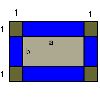
Seven small rectangular pictures have one inch wide frames. The frames are removed and the pictures are fitted together like a jigsaw to make a rectangle of length 12 inches. Find the dimensions of. . . .
You can move the 4 pieces of the jigsaw and fit them into both outlines. Explain what has happened to the missing one unit of area.
It is possible to dissect any square into smaller squares. What is the minimum number of squares a 13 by 13 square can be dissected into?
Can you maximise the area available to a grazing goat?
What are the areas of these triangles? What do you notice? Can you generalise to other "families" of triangles?
Draw some isosceles triangles with an area of $9$cm$^2$ and a vertex at (20,20). If all the vertices must have whole number coordinates, how many is it possible to draw?
Is it possible to remove ten unit cubes from a 3 by 3 by 3 cube made from 27 unit cubes so that the surface area of the remaining solid is the same as the surface area of the original 3 by 3 by 3. . . .
Can you find the area of a parallelogram defined by two vectors?
It's easy to work out the areas of most squares that we meet, but what if they were tilted?
The area of a square inscribed in a circle with a unit radius is, satisfyingly, 2. What is the area of a regular hexagon inscribed in a circle with a unit radius?
Do you know how to find the area of a triangle? You can count the squares. What happens if we turn the triangle on end? Press the button and see. Try counting the number of units in the triangle now. . . .
This rectangle is cut into five pieces which fit exactly into a triangular outline and also into a square outline where the triangle, the rectangle and the square have equal areas.
A point P is selected anywhere inside an equilateral triangle. What can you say about the sum of the perpendicular distances from P to the sides of the triangle? Can you prove your conjecture?
In this problem we are faced with an apparently easy area problem, but it has gone horribly wrong! What happened?
Make an eight by eight square, the layout is the same as a chessboard. You can print out and use the square below. What is the area of the square? Divide the square in the way shown by the red dashed. . . .
How have "Warmsnug" arrived at the prices shown on their windows? Which window has been given an incorrect price?
Points P, Q, R and S each divide the sides AB, BC, CD and DA respectively in the ratio of 2 : 1. Join the points. What is the area of the parallelogram PQRS in relation to the original rectangle?
Determine the total shaded area of the 'kissing triangles'.
Have a go at creating these images based on circles. What do you notice about the areas of the different sections?
If you have only 40 metres of fencing available, what is the maximum area of land you can fence off?
Semicircles are drawn on the sides of a rectangle ABCD. A circle passing through points ABCD carves out four crescent-shaped regions. Prove that the sum of the areas of the four crescents is equal to. . . .
A red square and a blue square overlap so that the corner of the red square rests on the centre of the blue square. Show that, whatever the orientation of the red square, it covers a quarter of the. . . .
Cut off three right angled isosceles triangles to produce a pentagon. With two lines, cut the pentagon into three parts which can be rearranged into another square.
Can you find rectangles where the value of the area is the same as the value of the perimeter?
Polygons drawn on square dotty paper have dots on their perimeter (p) and often internal (i) ones as well. Find a relationship between p, i and the area of the polygons.
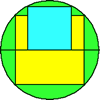
Which is a better fit, a square peg in a round hole or a round peg in a square hole?
What is the ratio of the area of a square inscribed in a semicircle to the area of the square inscribed in the entire circle?
Take any rectangle ABCD such that AB > BC. The point P is on AB and Q is on CD. Show that there is exactly one position of P and Q such that APCQ is a rhombus.
How can you change the area of a shape but keep its perimeter the same? How can you change the perimeter but keep the area the same?
Can you work out the area of the inner square and give an explanation of how you did it?
I'm thinking of a rectangle with an area of 24. What could its perimeter be?
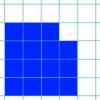
A hallway floor is tiled and each tile is one foot square. Given that the number of tiles around the perimeter is EXACTLY half the total number of tiles, find the possible dimensions of the hallway.
ABC and DEF are equilateral triangles of side 3 and 4 respectively. Construct an equilateral triangle whose area is the sum of the area of ABC and DEF.
How efficiently can you pack together disks?
Prove that a triangle with sides of length 5, 5 and 6 has the same area as a triangle with sides of length 5, 5 and 8. Find other pairs of non-congruent isosceles triangles which have equal areas.
This shape comprises four semi-circles. What is the relationship between the area of the shaded region and the area of the circle on AB as diameter?
Six circular discs are packed in different-shaped boxes so that the discs touch their neighbours and the sides of the box. Can you put the boxes in order according to the areas of their bases?
A square of area 40 square cms is inscribed in a semicircle. Find the area of the square that could be inscribed in a circle of the same radius.
What is the area of the quadrilateral APOQ? Working on the building blocks will give you some insights that may help you to work it out.
Three squares are drawn on the sides of a triangle ABC. Their areas are respectively 18 000, 20 000 and 26 000 square centimetres. If the outer vertices of the squares are joined, three more. . . .
Explore one of these five pictures.
A task which depends on members of the group noticing the needs of others and responding.
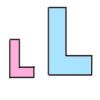
What happens to the area and volume of 2D and 3D shapes when you enlarge them?
What is the same and what is different about these circle questions? What connections can you make?
Bluey-green, white and transparent squares with a few odd bits of shapes around the perimeter. But, how many squares are there of each type in the complete circle? Study the picture and make. . . .
You have a 12 by 9 foot carpet with an 8 by 1 foot hole exactly in the middle. Cut the carpet into two pieces to make a 10 by 10 foot square carpet.
Draw two circles, each of radius 1 unit, so that each circle goes through the centre of the other one. What is the area of the overlap?
An activity for high-attaining learners which involves making a new cylinder from a cardboard tube.
Follow the instructions and you can take a rectangle, cut it into 4 pieces, discard two small triangles, put together the remaining two pieces and end up with a rectangle the same size. Try it!
This article, written for teachers, discusses the merits of different kinds of resources: those which involve exploration and those which centre on calculation.