 Links to the NRICH website Home page

30 April (Primary), 1 May (Secondary)
Resources tagged with: Arithmetic sequences
There are 22 results
Broad Topics > Patterns, sequences and structure > Arithmetic sequences
Growing Surprises
Can you find the connections between linear and quadratic patterns?


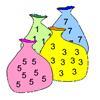
What Numbers Can We Make Now?
Imagine we have four bags containing numbers from a sequence. What numbers can we make now?

Seven Squares
Watch these videos to see how Phoebe, Alice and Luke chose to draw 7 squares. How would they draw 100?
Steel Cables
Some students have been working out the number of strands needed for different sizes of cable. Can you make sense of their solutions?
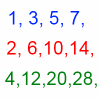
Odds, Evens and More Evens
Alison, Bernard and Charlie have been exploring sequences of odd and even numbers, which raise some intriguing questions...

What Numbers Can We Make?
Imagine we have four bags containing a large number of 1s, 4s, 7s and 10s. What numbers can we make?

Charlie's Delightful Machine
Here is a machine with four coloured lights. Can you develop a strategy to work out the rules controlling each light?

A Little Light Thinking
Here is a machine with four coloured lights. Can you make two lights switch on at once? Three lights? All four lights?

Shifting Times Tables
Can you find a way to identify times tables after they have been shifted up or down?

Slick Summing
Watch the video to see how Charlie works out the sum. Can you adapt his method?

Mystic Rose
Use the animation to help you work out how many lines are needed to draw mystic roses of different sizes.

Elevenses
How many pairs of numbers can you find that add up to a multiple of 11? Do you notice anything interesting about your results?
Squares in Rectangles
A 2 by 3 rectangle contains 8 squares and a 3 by 4 rectangle contains 20 squares. What size rectangle(s) contain(s) exactly 100 squares? Can you find them all?

Coordinate Patterns
Charlie and Alison have been drawing patterns on coordinate grids. Can you picture where the patterns lead?

Seven Squares - Group-worthy Task
Choose a couple of the sequences. Try to picture how to make the next, and the next, and the next... Can you describe your reasoning?
More Number Pyramids
When number pyramids have a sequence on the bottom layer, some interesting patterns emerge...
Days and Dates
Investigate how you can work out what day of the week your birthday will be on next year, and the year after...

Maxagon
What's the greatest number of sides a polygon on a dotty grid could have?
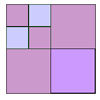
Squares, Squares and More Squares
Can you dissect a square into: 4, 7, 10, 13... other squares? 6, 9, 12, 15... other squares? 8, 11, 14... other squares?

Series Sums
Let S1 = 1 , S2 = 2 + 3, S3 = 4 + 5 + 6 ,........ Calculate S17.
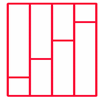
Natural Sum
The picture illustrates the sum 1 + 2 + 3 + 4 = (4 x 5)/2. Prove the general formula for the sum of the first n natural numbers and the formula for the sum of the cubes of the first n natural numbers.