

Witch of Agnesi


Sketch the members of the family of graphs given by $y = a^3/(x^2+a^2)$ for $a=1, 2$ and $3$.
Problem
Sketch the members of the family of graphs given by $$y = {a^3\over (x^2+a^2)}$$ for $a=1$, $2$ and $3$.
Getting Started
Consider symmetry.
Find the critical values (turning points).
Consider what happens to the graphs for large $x$ (possitive and negative) and hence find the asymptote.
Student Solutions
Sanjeet sent us this graph, showing the three curves on the same graph:
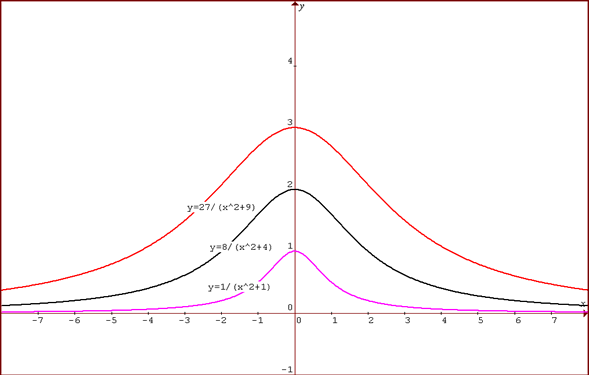
For different values of $a$ the graphs have the equation: $$y = {a^3\over (x^2+a^2)}$$ Differentiating $${dy\over dx} = - {2a^3x\over (x^2+a^2)^2}.$$ So the critical value is at $(0,a)$. Near this point, for small negative $x$ the gradient is positive and the function increasing and for small positive $x$ the gradient is negative and the function decreasing so this is a maximum point.
The value of $y$ is always positive so the entire graph lies above the $x$ axis and the graph is symmetrical about $x=0$ because $f(-x)=f(x)$.
For large $x$ the value of $y$ tends to zero so the line $y=0$ is an asymptote.
Teachers' Resources
Using NRICH Tasks Richly describes ways in which teachers and learners can work with NRICH tasks in the classroom.
Why do this problem?
The problem gives practice in the usual techniques for curve sketching (considering symmetry, finding turning points, looking for asymptotes). It also introduces the idea of a family of curves.
Possible approach
Suggest different members of the class sketch the different graphs (for $a=1$, $2$ and $3$). Have a class discussion about the results they find.
Key questions
Will the graphs have a similar shape for all values of $a$?
What about negative values of $a$?
Possible extension
If the class can differentiate simple functions defined parametrically or implicitly then they could also try: Squareness and Folium of Descartes.