

Handshakes

 2 out of 3
Can you find an efficient method to work out how many handshakes there would be if hundreds of people met?
Problem
Seven mathematicians met up one week.
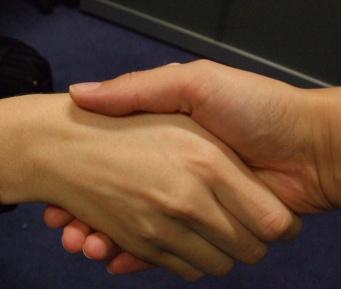
The first mathematician shook hands with all the others.
The second one shook hands with all the others apart from the first one (since they had already shaken hands).
The third one shook hands with all the others apart from the first and the second mathematicians, and so on, until everyone had shaken hands with everyone else.
How many handshakes were there altogether?
- 6214
- 3655
- 7626
- 8656
You may wish to try the problems Picturing Triangle Numbers and Mystic Rose. Can you see why we chose to publish these three problems together?
You may also be interested in reading the article Clever Carl, the story of a young mathematician who came up with an efficient method for adding lots of consecutive numbers.
Getting Started
If you were one of ten people at a party, how many times would you shake hands?
How many times would everyone else shake hands?
How could you use this to work out the total number of handshakes?
Check your method makes sense by trying some examples of small gatherings.
Student Solutions
A student from Mearns Castle made the useful connection with another problem published this month:
This is similar to finding the number of lines in Mystic Rose.
Say there are n people. The first person shakes his hand with the other n-1 people.
The second person then shakes his hand with the other n-2 people.
And so on until the (n-1)th person shakes his hand with the nth person.
So the number of handshakes is (n-1) + (n-2)... + 3 + 2 + 1 which equals (n-1)(n)/2.
Another way of considering it is that each person has a total of n-1 handshakes, and there are n people, so there would be (n-1)(n) handshakes, but this includes each handshake twice (1 and 2, 2 and 1) so dividing by 2 gives the correct answer.
Aswaath from the Garden International School in Kuala Lumpur, Malaysia mentioned that the method for solving this problem connected with the method used by Gauss when he was still a young student.
Joe from Hove Park Lower School also noticed connections with other work:
If, for example, 10 mathematicians met, the first will make 9 handshakes, the second makes 8, the third makes 7 and so on until the tenth finds he has already made handshakes with everyone and so makes no more.
This gives 9+8+7+6+5+4+3+2+1+0 handshakes and this is 45.
But look at the sequence... it is the 9th triangular number.
(See Picturing Triangle Numbers and/or Clever Carl)
The formula for the Tth triangular number is T(T+1)/2
With the handshake problem, if there are n people, then the number of handshakes is equivalent to the (n-1)th triangular number.
Subsituting T = n-1 in the formula for triangular numbers, we can deduce a formula for the number of handshakes between n people:
Number of handshakes = (n-1)(n)/2
Jayme from the Garden International School agreed and used this insight to correct Sam's reasoning:
Sam's method isn't right because he did not divide the answer by 2. If you do not divide it by 2, you will be counting the number of handshakes between pairs of mathematicians twice.
If 20 mathematicians meet:
20 x 19 = 380
380 / 2 = 190 (total number of handshakes)
If 161 mathematicians meet:
161 x 160 = 25760
25760 / 2 = 12880 (total number of handshakes)
Could there be exactly 4851 handshakes at a gathering where everyone shakes hands?
We know that 4851 handshakes is between 20 mathematicians and 160 mathematicians. So, let's start by trying out 100 mathematicians.
Total number of handshakes = 100 x 99 / 2 = 4950
That's too many so now I'll try 99 mathematicians.
Total number of handshakes = 99 x 98 / 2 = 4851
Therefore, there could be exactly 4851 handshakes when 99 mathematicians meet.
Could there be exactly 6214 handshakes at a gathering where everyone shakes hands?
Let's start by trying out 112 mathematicians.
Total number of handshakes = 112 x 111/ 2 = 6216
That's too many so now I'll try 111 mathematicians.
Total number of handshakes = 111 x 110 / 2 = 6105
That's too few so there cannot be exactly 6214 handshakes.
Joseph from Bradon Forest School and Tabitha from The Norwood School used similar reasoning:
Sam's reasoning is wrong because you should only count the unique handshakes that have taken place. He should modify his method by dividing by 2. Each handshake involves 2 mathematicians so only half of Sam's handshakes are unique.
$161$ mathematicians
Total handshakes = $161 \times 160/2 = 12880$
Quick Method:
$N$ = number of mathematicians
Total handshakes = $N\times (N - 1)/2$ or $(N^2 -N)/2$
Can $4851$ be the exact number of handshakes at a gathering?
$(N^2 -N)/2 = 4851$
$(N^2 -N)= 9702$
$9702 = approx. 10000 = 100^2$
Try $N = 99$
$99^2 -99 = 97024$
So yes, if $99$ mathematicians meet there will be $4851$ handshakes
$6214$ handshakes?
No, the nearest triangle number is $6216$, and $6214$ is not a triangle number
$3655$ handshakes?
Yes, $86$ Mathematicians
$7626$ handshakes?
Yes, $124$ Mathematicians
$8656$ handshakes?
No, the nearest triangle number is $8646$, and $8656$ is not a triangle number.
We received many more correct solutions, including very clear ones from Siddhartha and Tasuku from the Garden International School in Kuala Lumpur, Ben from Bedminster Down School, Abhinav from Bangkok Patana School and Luke from Maidstone Grammar School. Well done and thank you to you all.
Teachers' Resources
Using NRICH Tasks Richly describes ways in which teachers and learners can work with NRICH tasks in the classroom.
Why do this problem?
This problem offers students an opportunity to relate numerical ideas to real life contexts.
Possible approach
Ask for seven volunteers to come and stand at the front of the class, and ask each volunteer to shake hands with everyone else, with the rest of the class counting how many handshakes take place. Was it easy to count? Would it be useful for the volunteers to shake hands in a more systematic manner? Repeat the process in the way suggested in the problem.
Allow some time for students to work out how many handshakes there would be with 8, 9 and 10 people, and discuss answers and methods.
Now present Sam's method and Helen's method, and ask the class to judge which method gives the correct answer.
"What is wrong with the other method?"
For a class that has been introduced to algebra, students could express "Sam's method" and "Helen's method" algebraically.
Finally, ask them to work out whether the following numbers could be the number of handshakes at a mathematical gathering, and how large those gatherings would be:
- 4851
- 6214
- 3655
- 7626
- 8656
Key questions
How does each method for working out the total number of handshakes relate to different ways of describing what happens when everyone in a room shakes hands?
Possible extension
Can you have a gathering with 9, 19, 29, 39, ... handshakes? Are these impossible? How do you know? What other impossible families of gatherings can you find?
Could there ever be a gathering with a multiple of 1000 handshakes? Give some examples.
Possible support