

Numbers as Shapes

 2 out of 3
Use cubes to continue making the numbers from 7 to 20. Are they sticks, rectangles or squares?
Problem
Here are the numbers $1$ to $6$ drawn using coloured squares:
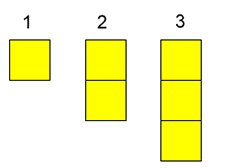
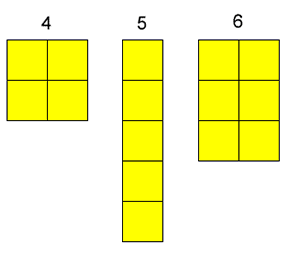
We can call these numbers squares, rectangles or sticks.
$1$ is a square but just a single one.
We can't make $2$ into a square so $2$ is a stick.
We can't make $3$ into a square or a rectangle so $3$ can only be a stick.
We can make $4$ into a square.
We can't make $5$ into a square or a rectangle, so $5$ can only be a stick.
We can't make $6$ into a square, but we can make $6$ into a rectangle.
If you had $7$ yellow squares, what could you make them into? A square, a rectangle or a stick? How about $8$ squares?
Try this with the numbers up to and including $20$.
Which ones can only be sticks?
Which ones can make rectangles?
Which ones are squares?
What do you notice?
This problem was inspired by a session at an ATM conference, led by Tandi Clausen-May.
Getting Started
It might be a good idea to find some cubes or tiles so you can make the numbers. Or you could use some squared paper and colour the squares.
Student Solutions
Susie sent in a table to show her solution to this problem:
| Numbers that can be squares | Numbers that can be sticks | Numbers that can be rectangles | Numbers that can only be sticks |
| 1 | 2 | 6 | 2 |
| 4 | 3 | 8 | 3 |
| 9 | 4 | 10 | 5 |
| 16 | 5 | 12 | 7 |
| 6 | 14 | 11 | |
| 7 | 15 | 13 | |
| 8 | 16 | 17 | |
| 9 | 18 | 19 | |
| 10 | 20 | ||
| 11 | |||
| 12 | |||
| 13 | |||
| 14 | |||
| 15 | |||
| 16 | |||
| 17 | |||
| 18 | |||
| 19 | |||
| 20 |
Susie also thought:
Children from Rampart School in the US sent a very full solution. They said:
The prime numbers from $1$ to $20$ ($2, 3, 5, 7, 11, 13, 17$, and $19$) can only be sticks. Each prime number has only two factors, $1$ and itself, so none of them can make rectangles. They can only make sticks of dimension $1 \times $ the prime number.
The numbers that are neither prime nor square ($6, 8, 10, 12, 14, 15, 18, 20$) can make rectangles because they all have factors other than $1$ and themselves. For example, $20$ has the factors $1$ and $20$, $2$ and $10$, and $4$ and $5$.
This leaves the square numbers that, subsequently, are the only numbers that can form the squares, for obvious reasons. Every square number can have the form $n \times n$, which also relates to the dimensions of the square.
So, we notice that only square numbers can form squares; prime numbers form sticks; and the composite, non-square numbers form rectangles.
Thank you also to Jack from Allerton Grange, Sophie from Belgium and Nathan from Rushmore Primary who sent in well-explained solutions.
Teachers' Resources
Using NRICH Tasks Richly describes ways in which teachers and learners can work with NRICH tasks in the classroom.
Why do this problem?
The idea of this problem is to give pupils a tool for visualising numbers. It is not intended to teach the vocabulary of square numbers, multiples and primes necessarily.
Possible approach
Key questions
Possible extension
Trying higher numbers will appeal to some children. Encourage them to predict what 'kind' of number each will be before creating a model or drawing. Some children will enjoy learning the words to describe these numbers - squares, multiples and primes.
Possible support
It would be a good idea for learners to have some cubes or tiles to make the numbers with, or to use some squared paper and colour the squares.