

Fibonacci's Three Wishes 2
A story from the past continued....
The story of Fibonacci's three wishes continues. If you didn't read the first part last month, you will find it here .
Well.... Fibonacci (say it Fib-o-narchee) still had two wishes to go: a sailing boat of his own, and to be clever and famous enough for the Emperor to want to meet him. The same girl that had taught Fibonacci to do arithmetic also suggested that he could breed rabbits, then sell their fur until he had enough money to buy his boat. So Fibonacci bought a pair of rabbits.

He had to calculate how long it would take to save enough money for his boat and from this came a famous problem: If a pair of rabbits gives birth to another pair every month, then after two months each new pair gives birth to another pair, and so on, how many pairs of rabbits would there be after a year? (Think about it - it's tricky. Remember the original pair keeps breeding too).
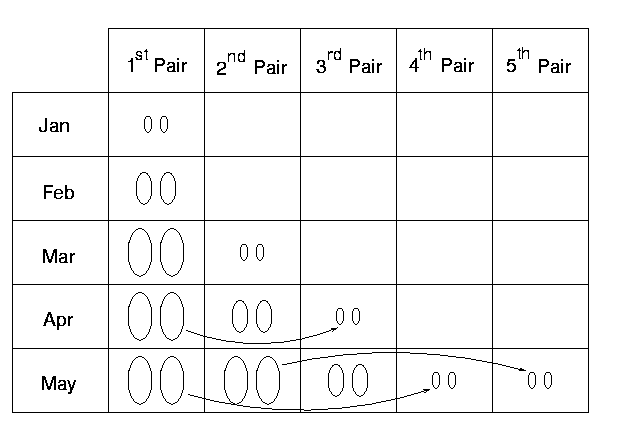
When Fibonacci solved this problem he discovered a special number pattern:
1, 1, 2, 3, 5, 8, 13, 21....
This means that in January there was one pair of rabbits, in February there was still one pair, in March there were two pairs, April three pairs and so on. (Can you see how to get the next number?) But what about the boat? Fibonacci's father became annoyed about all the smelly rabbits and bought him a boat so he would get rid of them. That left one wish to go.
Fibonacci became a merchant like his father. He wrote a book about trading and commerce, and explained how the Hindu-Arabic number system was a much better way do mathematics than Roman Numerals. This book made Fibonacci so famous that in 1225 the Emperor, who was also a mathematician, came to visit Fibonacci. So all of Fibonacci's wishes had come true.
(And he was right about the Tower of Pisa too. Not bad for a 'blockhead'!)
The Fibonacci number pattern has fascinated people ever since. These numbers keep appearing in unexpected places, like the numbers of petals on flowers, and the spirals of seed cases on pine cones. Have a look at the Fibonacci website for lots more!