

Three by One


There are many different methods to solve this geometrical problem - how many can you find?
Problem
$ABCD$ is a rectangle where $BC$ = $3AB$. $P$ and $Q$ are points on $BC$ such that $BP$ = $PQ$ = $QC$.
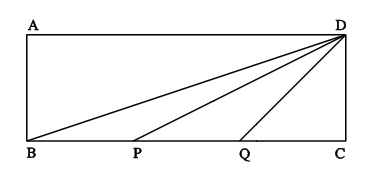
Show that: angle $DBC$ + angle $DPC$ = angle $DQC$
Generalise this result.
N.B. This problem can be tackled in at least 8 different ways using different mathematics learnt in the last two years in school and earlier. The methods are essentially the same when viewed from a more advanced perspective.
Getting Started
Here is a hint to help on you on the way :
Let $\alpha + \beta = \gamma$ and $\tan(\alpha + \beta) = \frac{\tan\alpha + \tan\beta}{1 - \tan\alpha\tan\beta}$
where $\alpha = \tan^{-1}{1\over3}$, $\beta = \tan^{-1}{1\over2}$, $\gamma = \tan^{-1}1$.
Student Solutions
The solutions produced here by school students show eight different methods. Reflection on these methods will help other students to see something of the 'bigger picture' in a way they will not experience from ploughing through the syllabus and working from textbooks (although that is also absolutely necessary).
Eight distinct proofs were given to this problem by two students, Alex and Neil (Madras College) using respectively sines, cosines, tangents, vectors, matrices, coordinate geometry, complex numbers and pure geometry.
Teachers' Resources
Using NRICH Tasks Richly describes ways in which teachers and learners can work with NRICH tasks in the classroom.
Why do this problem?
In this one problem you meet many important aspects of mathematics. It illustrates how much mathematics is inter-related. It shows the value of not being content to find one solution, but of asking yourself "could I solve this another way?" or "have I found the best method?" It is very satisfying to feel you have somehow got to the very essence of a mathematical idea by looking at it in the right way, though of course there can me many "right ways" to look at it.
Also this problem provides a good example of how you can generalise from a result that is really a simple case of a much more general result. Are you content just to solve a problem or do you ask yourself "what if ...." and try to find more general results?
Possible approach
You could challenge your class to find as many different methods of solving this problem as possible. You could tell them that one pair of school students found 8 different methods. At some stage of this work, and depending on your students' mathematical experience, you might mention that these two students used respectively sines, cosines, tangents, vectors, matrices, coordinate geometry, complex numbers and pure geometry.
Perhaps your students could work in pairs. They could come to the board and present their solutions to the rest of the class and/or make posters for the classroom wall. You could see collectively how many different methods your class can find.
Key questions
What lengths in the diagram can we find?
What do we know about sines, cosines, tangents, vectors, matrices, coordinate geometry, complex numbers and pure geometry that we can use to prove this result?
How might we generalise this result?
Possible extension
The linked article Why Stop at Three by One? beautifully generalises this result.