In this question [$A$]
means the concentration of the
chemical $A$ at equilibrium.
For a balanced chemical equation, where $A, B, C$ and $D$ are
chemicals in aqueous solution and $a, b, c, d$ are whole
numbers,
$$
aA + bB \leftrightarrows_K cC + dD+ eH_2O
$$
the law of mass action
tells us that for a fixed temperature, there is a constant $K$
(called the equilibrium constant) such that
$$
\frac{[C]^c[D]^d}{[A]^a[B]^b} = K
$$
(note the absence of the solvent concentration $[H_2O]$ ).
In the blood, the carbonic-acid-bicarbonate buffer prevents large
changes in the pH of the blood. Chemically, it consists of two
reactions which are simultaneously in equilibrium
$$H^+ +HCO^-_3+H_2O \leftrightarrows_{K_1} H_2CO_3+H_2O
\leftrightarrows_{K_2} 2H_2O+CO_2$$
Show that
$$
pH =pK -\log \left(\frac{[CO_2]}{[HCO^-_3]}\right)\quad
\mbox{where }K=\frac{1}{K_1K_2}
$$
Think about this equation. It shows that the pH of the blood is
dependent on the ratio of the concentrations of $CO_2$ and
$HCO^-_3$. These are large in the blood, so small changes in the
relative concentrations leads to very small changes in the pH of
the blood. They act as a 'buffer' against pH change.
Now, make a new variable $x$ to be the fraction of the buffer in
the form of $HCO^-_3$. Thus,
$$
x = \frac{[HCO^-_3]}{[HCO^-_3]+[H_2CO_3]+[CO_2]}
$$
Show that
$$
pH = pK-\log\left(\frac{1}{x}-1 -K_1[H^+]\right)
$$
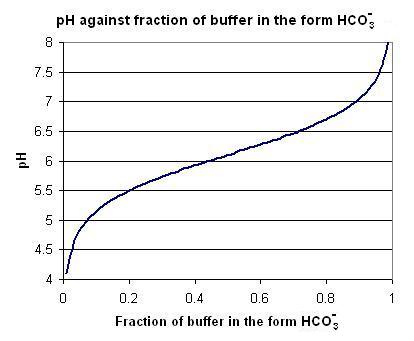
By taking the value $pK=6.1$ and treating $K_1[H^+]$ as very
small, reproduce the titration curve
Extension:
1. Why is it numerically valid to ignore the $[H^+]$ term in the
equation giving rise to the graph?
2. With the assumption that $K_1[H^+]=0$, use calculus to show
that the second derivative of the pH is zero when $x=0.5$.
Graphically, what does this correspond to?