By Henry Kwok
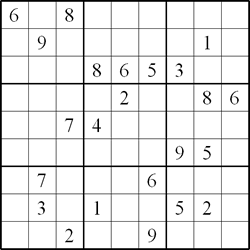
| Twin
A |
Twin
B |
 |
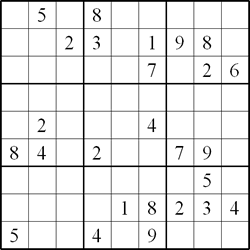 |
Here is a
Word document with the two Sudoko grids that you can download for
printing.
Rules of Twin Equivalent Sudoku
This Sudoku consists of a pair of linked standard Sudoku
puzzles each with some starting digits. As usual, the object of
this Sudoku is to fill in the whole of each 9x9 grid with
digits 1 through 9 so that each row, each column and each block
contain all the digits 1 through 9.
Twin B is related to twin A in the following ways:
1. Given that twin A is the original puzzle, we can create an
equivalent puzzle from twin A by swapping a horizontal/vertical
chute or band of 3 blocks with another horizontal/vertical
chute or band of 3 blocks.
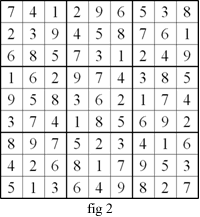
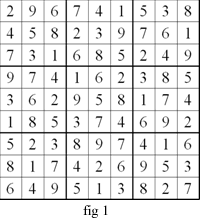
For example, an equivalent puzzle (fig 2) is created from fig 1
by swapping the left vertical chute of 3 blocks with the middle
vertical chute of 3 blocks.
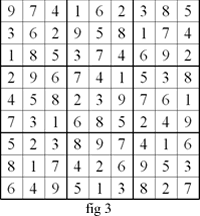
Similarly an equivalent puzzle (fig 3) can be created from fig
1 by swapping the top horizontal chute of 3 blocks with the
middle horizontal chute of 3 blocks.
2. After swapping the chutes, we can create a third equivalent
puzzle (twin B) by renaming all the elements of second
equivalent puzzle.
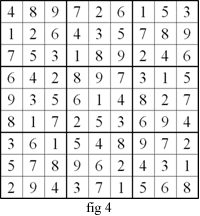
For example, we create an equivalent puzzle (fig 4) by renaming
the elements of fig 3 in the following way:
fig 3 ® fig 4 1 ®7
2 ® 6
3® 1
4 ® 9
5 ® 3
6 ® 2
7 ® 8
8 ® 5
9 ® 4
The four puzzles (fig 1 to fig 4) are equivalent to one
another. Equivalent puzzles can also be created from fig 1 and
fig 2 by renaming the elements in the respective grids. Instead
of calling fig 1 and fig 4 by the clumsy name of 'twin
element-renaming chute-swapping sudoku', we can simply call them
'twin equivalent sudoku'.