|
Although the first set of rules for dealing with
negative numbers was stated in the 7th century by the
Indian mathematician Brahmagupta, it is surprising that
in 1758 the British mathematician Francis Maseres was
claiming that negative numbers
"... darken the very whole doctrines of the equations
and make dark of the things which are in their nature
excessively obvious and simple" .
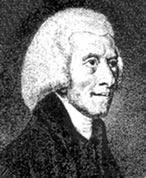
Maseres and his contemporary, William Friend took the
view that negative numbers did not exist. However,
other mathematicians around the same time had decided
that negative numbers could be used as long as they had
been eliminated during the calculations where they
appeared.
|
 |
It was not until the 19th century
when British mathematicians like De Morgan, Peacock, and others,
began to investigate the 'laws of arithmetic' in terms of logical
definitions that the problem of negative numbers was finally
sorted out.
However, there were references to negative numbers far
earlier...
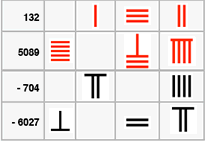 |
In 200 BCE the Chinese number rod system (see note1
below) represented positive numbers in Red and Negative
numbers in black. An article describing this system can be
found here . These were used for commercial and tax
calculations where the black cancelled out the red. The
amount sold was positive (because of receiving money) and
the amount spent in purchasing something was negative
(because of paying out); so a money balance was positive,
and a deficit negative. |
The concept also appeared in Astronomy where the ideas of
'strong' and 'weak' were used for approximating a number from
above or below. For example approaching 5 from above means for
example, starting with 5.2 you can find better approximations
5.1, 5.05, 5.025. Thus 5.025 was called a 'strong'
approximation and a number like 4.9 'weak'. So 'strong' numbers
were called positive and 'weak' numbers negative
In India , negative
numbers did not appear until about 620 CE in the work of
Brahmagupta (598 - 670) who used the ideas of 'fortunes' and
'debts' for positive and negative. By this time a system based on
place-value was established in India, with zero being used in the
Indian number sytem. Brahmagupta used a special sign for
negatives and stated the rules for dealing with positive and
negative quantities as follows:
|
A debt minus zero is a debt.
A fortune minus zero is a fortune.
Zero minus zero is a zero.
A debt subtracted from zero is a fortune.
A fortune subtracted from zero is a debt.
The product of zero multiplied by a debt or fortune is
zero.
The product of zero multiplied by zero is zero.
The product or quotient of two fortunes is one fortune.
The product or quotient of two debts is one fortune.
The product or quotient of a debt and a fortune is a
debt.
The product or
quotient of a fortune and a debt is a debt.
|
 |
The conflict between geometry and algebra
The ancient Greeks did
not really address the problem of negative numbers, because
their mathematics was founded on geometrical ideas. Lengths,
areas, and volumes resulting from geometrical constructions
necessarily all had to be positive. Their proofs consisted of
logical arguments based on the idea of magnitude. Magnitudes
were represented by a line or an area, and not by a number
(like 4.3 metres or 26.5 cubic centimetres). In this way they
could deal with 'awkward' numbers like square roots by
representing them as a line. For example, you can draw the
diagonal of a square without having to measure it (see note 2
below).
About 300 CE, the Alexandrian mathematician Diophantus (200 -
c.284 CE) wrote his Arithmetica , a collection of
problems where he developed a series of symbols to represent the
'unknown' in a problem, and powers of numbers. He dealt with what
we now call linear and quadratic equations. In one problem
Diophantus wrote the equivalent of 4 = 4x + 20 which would give a
negative result, and he called this result 'absurd'.
In the 9th century in Baghdad Al - Khwarizmi (c.780 - c.850
CE) presented six standard forms for linear or quadratic
equations and produced solutions using algebraic methods and
geometrical diagrams. In his algebraic methodshe acknowledged
that he derived ideas from the work of Brahmagupta and therefore
was happy with the notion of negative numbers. However, his
geometrical models (based on the work of Greek mathematicians)
persuaded him that negative results were meaningless (how can you
have a negative square?). In a separate treatise on the laws of
inheritance, Al-Khwarizmi represents negative quantities as
debts.
In the 10th century Abul -Wafa (940-998 CE) used negative numbers
to represent a debt in his work on 'what is necessary from the
science of arithmetic for scribes and businessmen'?. This seems
to be the only place where negative numbers have been found in
medieval Arabic mathematics. Abul-Wafa gives a general rule and
gives a special case where subtraction of 5 from 3 gives a "debt"
of 2. He then multiples this by 10 to obtain a "debt" of 20,
which when added to a 'fortune' of 35 gives 15.
In the 12th century Al - Samawal (1130 - 1180) had produced an
algebra where he stated that:
- if we subtract a positive number from an 'empty power', the
same negative number remains,
- if we subtract the negative number from an 'empty power',
the same positive number remains,
- the product of a negative number by a positive number is
negative, and by a negative number is positive.
Negative numbers did not begin to appear in Europe until the
15th century when scholars began to study and translate the
ancient texts that had been recovered from Islamic and
Byzantine sources. This began a process of building on ideas
that had gone before, and the major spur to the development in
mathematics was the problem of solving quadratic and cubic
equations.
As we have seen, practical applications of mathematics often
motivate new ideas and the negative number concept was kept
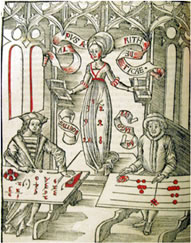
alive as a useful device by the Franciscan friar Luca Pacioli
(1445 - 1517) in his Summa published in 1494, where he
is credited with inventing double entry book-keeping.
Solving equations
The story of the solution of equations begins in Italy in the
16th century (see note 3 below). This story is full of intrigue
and deception because methods of solution were kept secret. The issue
which caused most consternation at the time was the
meaning of
. In fact, Cardano (1501 - 1576) in his Ars Magna of 1545 had
to solve a problem where
appeared.
Cardano found a sensible answer (see note 4 below) by working
through the algorithm, but he called these numbers 'ficticious'
because not only did they disappear during the calculation, but
they did not seem to have any real meaning. However, by 1572, the
Italian engineer, Bombelli (1526 - 1572) had provided the correct
rules for working with these 'imaginary'numbers(see note 5
below).
In the 17th and 18th century, while they might not have been
comfortable with their 'meaning' many mathematicians were
routinely working with negative and imaginary numbers in the
theory of equations and in the development of the calculus.
The English mathematician, John
Wallis (1616 - 1703) is credited with giving some meaning to
negative numbers by inventing the number line, and in the early
18th century a controversy ensued between Leibniz, Johan
Bernoulli, Euler and d'Alembert about whether Log(- x) was the
same as Log(x).
By the beginning of the 19th century Caspar Wessel (1745 - 1818)
and Jean Argand (1768 - 1822) had produced different mathematical
representations of 'imaginary'numbers, and around the same time
Augustus De Morgan (1806 - 1871), George Peacock (1791 - 1858)
William Hamilton (1805 - 1865) and others began to work on the
'logic'of arithmetic and algebra and a clearer definition of
negative numbers, imaginary quantities, and the nature of the
operations on them began to emerge.
Negative numbers and imaginaries are now built into the
mathematical models of the physical world of science,
engineering and the commercial world.
There are many applications of negative numbers today in
banking, commodity markets, electrical engineering, and
anywhere we use a frame of reference as in coordinate geometry,
or relativity theory.
Pedagogical Note:
It
seems that the problems that people had (and now have - see the
Lottery incident ) in understanding the use of negative
numbers concerns:
- the difference between the operation of subtraction and the
object (a negative
number), since the same sign is used for both
- the language involved like 'minus minus 3' as opposed to
'subtract negative 3'
- separating the physical model or analogy (be it profit/loss
or rise/fall in temperature or rotation/direction in the plane)
from the rules of operating on the entities.
References
English Mathematicians
Francis Maseres (1731 - 1824)
A dissertation on the use of the negative sign in algebra. (1758)
Fellow of Clare College Cambridge and Fellow of the Royal Society
William Frend
Principles of Algebra (1796)
Printed by J. Davis, for G. G. and J. Robinson, Paternoster Row
Other
Sources
Berggen, J.L. (1986) Episodes in the Mathematics of
Mediaeval Islam . Springer-Verlag N.Y. & Berlin.
Menninger, K. (1969) Number Words and Number
Symbols . M.I.T. Press Cambridge, Mass. &
London.
Schubring, G. (2005) Conflicts Between Generalization,
Rigor, and Intuition: Number Concepts Underlying the Development
of Analysis in 17 - 19th Century France and Germany .
Springer-Verlag N.Y.
Ifrah, G. (1998) The
Universal History of Numbers . Harvill Press, London.
Li Yan and Du Shiran (Tr. Crossley, J.N and Lun A. W. ) (1987)
Chinese Mathematics: a
Concise History . O.U.P. Oxford.
Web
References
Mactutor at St Andrews University http://www-history.mcs.st-and.ac.uk/history/
.
Notes
- The counting rod system was certainly in operation in the
period (475 - 221 BCE) - called the period of the 'Warring
States' [Yan & Shiran 1987, 7/8])
-
In our notation,
and
occurred
when finding the diagonal of a square or constructing the Golden
Section.
- The period from Pacioli (1494) to Descartes (1637), a
period of about 150 years brings the solution of equations to a
stage where they could be understood by school pupils
today.
-
In modern notation, Cardano's multiplication was
25 - -15 = 40
- Even though mathematicians did not find a suitable
representation for negative numbers, it did not prevent them
from following the ordinary rules of arithmetic and developing
rules for the imaginary numbers as well. This is where the
beauty of mathematical invention is not limited by the 'real'
world.