In the problem Dam
Busters 1 we looked at targetting a dam with a direct
hit.
In this case the plane could only just get close enough to the
dam to destroy its target.
A scientist has suggested developing a bomb which will bounce on
water when travelling transverse to the water at high speed. It
has been suggested that this bouncing bomb will enable the target
to be struck more centrally by releasing it from a larger
distance
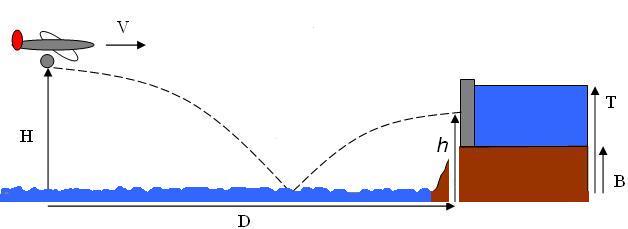
Several scientists have tried to calculate the height
h of the bouncing bomb
above sea level at the point at which it will be level with the
wall after the first bounce. The scientists agree on the overall
general form of the equation but cannot agree on some of the
signs and which way around some of the factors should go.
Can you decide whether each of
the signs in the equation should be 'plus one' or 'minus one'
(they can be different from each other)?
|
h = - |
1
2
|
g±1 |
é
ê
ë
|
æ
ç
è
|
V
D
|
ö
÷
ø
|
±1
|
-ÖX |
ù
ú
û
|
2
|
±egÖX |
é
ê
ë
|
æ
ç
è
|
V
D
|
ö
÷
ø
|
±1
|
-ÖX |
ù
ú
û
|
< T X = |
æ
ç
è
|
2H
g
|
ö
÷
ø
|
±1
|
|
|
In the equation, e is the coefficient of restitution for the
bomb striking the water. You do not need to derive the
equation, only to decide which configurations would give rise
to a sensible equation from a physical point of view.
Now that you have chosen the correct equation, explore the
heights and distances H and D which will enable a strike on
target when the coefficient of restitution is 0.8. The bomber
must fly below 200m and release the bomb at a minimum distance
of 1km from the target. The bomber can fly at up to 800 km per
hour.
What is the minimum value of the coefficient of restitution for
which this bombing strategy will work in this situation?
Extension : Derive
this equation used in the calculations
NOTES AND BACKGROUND
Bouncing bombs were indeed used in World War II to destroy
dams.
In 1941 Barnes Wallis, a scientist working for a British
aircraft company was commissioned to investigate ways to halt
the German war machine. He concluded that destruction of dams
in the industrial Ruhr region would be devastating to German
production. An 'Air Attack on the Dams Committee' was formed to
try to find targets.Of course, the dams were immensely strong
and very heavily defended. Barnes realised that the only way to
destroy a dam was for a bomb to explode at its foot, which was
protected by torpedo nets. The committee believed that this
problem was technologically intractable.
Thinking out of the box Barnes invented the bouncing bomb. In
the final attack the plane had to fly at 220 miles per hour, at
a height of 60 feet above the water and release the bomb from
exactly 425 yards.
You can read about this fascinating piece of wartime ingenuity
at, for example,
http://www.historylearningsite.co.uk/dambusters.htm
.