The Question
 |
What are numbers? Most people, even five year olds,
can answer that question to their own satisfaction. Many
different answers are given to this question, all more or
less acceptable within the discourse taking place.
Although negative, fractional and irrational numbers were
accepted by scholars in Europe in the sixteenth century,
and earlier in ancient civilisations in other parts of
the world, until the nineteenth century negative numbers
and complex numbers were often disparagingly referred to
as absurd numbers and imaginary numbers. These numbers
now play an essential part in mathematics, even school
mathematics, and schoolchildren learn about them.
|
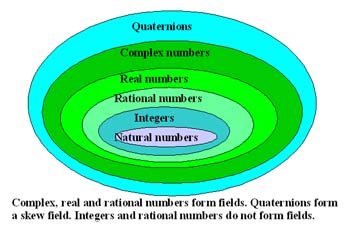
This brief descriptive article is intended as light reading for
the general reader. Here we shall explore the question in a
very informal way. We shall discuss different sets of numbers,
including quaternions and a brief mention of Clifford Algebras,
starting with counting numbers and meeting new sets of numbers,
each set containing within it the set of numbers discussed so
far. Quaternions are explored in more detail in the NRICH
problem
Two and Four Dimensional Numbers
In order to understand why there are different sorts of
numbers, and what they are, we need to consider how young
people meet the familiar number systems and how we broaden our
ideas of number as we learn more arithmetic. Many small
children are proud of themselves when they can count to one
hundred and a little later they have an experience of awe and
wonder when then first appreciate that counting goes on for
ever with no end. These children have a familiarity with
counting and the natural numbers, even with the concept of
infinity, before they meet a number system. Roughly speaking a
number system is a set of entities that can be combined,
according to agreed rules, by the operations of addition,
subtraction, multiplication and division, always producing
answers that are in the set.
Rules of Arithmetic
 |
Adding and sharing are transactions that we engage in
early in our lives and they take us beyond simple
counting into the realm of arithmetic. So we should
define numbers to be more than labels for naming and
recording the size of collections of objects that we have
counted. We need to think of numbers as entities that can
be combined according to an agreed set of rules which we
call arithmetic. The more we know about and use this
arithmetic, the more we appreciate that it can be
generalised and refined into more and more useful
mathematical tools for solving human problems of all
sorts.
|
 |
If we use numbers to describe the size of a collection
of objects we need a number for a set that has nothing in
it. So we need to expand our concept of number to include
zero. While the use of numbers, including place value,
dates back at least five thousand years, scholars in
Europe were still debating whether zero could be a number
as recently as five hundred years ago.
|
Inverses
Once we have an operation which combines two numbers to give another number,
can we undo that process? If we can add 7 what is the operation on the answer
which restores it to the original number?
 |
Subtraction is another natural idea based on concrete
experience, not of increasing the size of a collection of
objects by combining two collections, but of reducing the
size of a collection by removing some of the objects. If
we have 5 coins and we need 12 to buy something we can
ask how many more coins do we need, which number do we
add to five to make 12; this is equivalent to finding the
answer to 12 - 5, but what number do we add to 13 to make
9 or what is the answer to 9 - 13? If we say that there
is no answer to such subtractions then it is only because
we do not know about negative numbers. Once negative
numbers come onto the scene we have many uses for
them.
|
We can do arithmetic without knowing the mathematical language and nothing
so far is beyond the experience of a small child learning to read a
thermometer on a wintry day.
We can think of any subtraction as simply the addition of two integers so
subtraction is not essential to recording arithmetic operations. For example
9 - 13 = 9 + (-13) = -4. The integer -13 is called the inverse of the +13
because (+13) + (-13) = 0. Every integer has an inverse such that the number
added to its inverse gives zero. We are already working with the structure
and using the rules which define the arithmetic involved in adding integers.
This is an example of a mathematical structure called a group.
From the Natural Numbers to the Integers
Another way to explain the evolution of thinking that extends ideas of
counting and addition is to say that if we want to be able to solve all
equations of the form a + x = b, where a and b are given and we have to find x,
then for all such equations to have solutions we need to work in the set of
integers. For example 9 + x = 5 had no solution within the set of counting
numbers.
Rational Numbers
 |
In the same way as horizons are extended to include
negative numbers it is also everyone's experience to
learn that fractions are also numbers. Mathematicians
call these numbers rational numbers . Children are
interested in 'fair shares' even before they start school
so division is also based on concrete experience.
|
Addition and subtraction are inverse operations inextricably connected.
Similarly multiplication and division are inverse operations in the sense
that 5 ×4 = 20 and 20 ¸4 = 5.
It is not until we can work with the set of rational numbers that every
addition, subtraction, multiplication and division of two numbers in the
set gives an answer that is also a number in the set giving a 'self contained'
number system. The rules for the arithmetic of rational numbers
are simple. This set of rules defines what mathematicians call a field.
(1) The set of rational numbers is closed under addition, and associative,
the rational number zero is the additive identity and every rational number
has an additive inverse. We say rational numbers form a commutative group
under addition.
(2) The set of rational numbers, leaving out the number zero, is closed under
multiplication, and associative, the rational number one is the multiplicative
identity and every rational number in this set has a multiplictive inverse.
We say the rational numbers, leaving out the number zero, form a commutative
group under multiplication.
(3) When we add and multiply rational numbers we use the distributive law.
For example
|
3×(4 + 5) = 3 ×4 + 3 ×5 = 27. |
|
We need to extend our ideas of the arithmetic of whole numbers to include
fractions (rational numbers) because we cannot solve all equations of the
form ax = b, where a, b and x are integers, a and b are given and we have
to find x. If a, b and x are rational numbers then all such equations have
solutions.
Irrational Numbers
Many people use only rational numbers because, even though no rational
number will give exact measurements of even simple shapes, exact measurements
can be approximated to a high degree of accuracy by rational numbers. The
length of the diagonal of a unit square is Ö2 and this is an irrational
number, one that cannot be written as the quotient of two integers. It is
approximately 1.414 but it cannot be given exactly however many decimal places
we use. See the interactive proof sorter for the proof that
 Real Numbers The rational and irrational numbers together make up the real
numbers. Each real number corresponds to exactly one point on a line and all
the points on that line are represented by real numbers. We call this line
the real line. The real numbers are equivalent to one dimensional vectors
and, together with addition and multiplication, form a field. We have now
discussed two different examples of fields of numbers, the rationals
and the reals.
Complex Numbers
In the field of real numbers we can solve the equation x2 = a only when
a is positive but not when a is negative. Real numbers are good enough for
many mathematical purposes but clearly they have limitations. It is necessary to
recognise the existence of two dimensional numbers, the complex numbers, in order
to solve all quadratic equations. See
Real Numbers The rational and irrational numbers together make up the real
numbers. Each real number corresponds to exactly one point on a line and all
the points on that line are represented by real numbers. We call this line
the real line. The real numbers are equivalent to one dimensional vectors
and, together with addition and multiplication, form a field. We have now
discussed two different examples of fields of numbers, the rationals
and the reals.
Complex Numbers
In the field of real numbers we can solve the equation x2 = a only when
a is positive but not when a is negative. Real numbers are good enough for
many mathematical purposes but clearly they have limitations. It is necessary to
recognise the existence of two dimensional numbers, the complex numbers, in order
to solve all quadratic equations. See
In 1799 Gauss proved the Fundamental Theorem of Algebra: every polynomial
equation over the complex numbers has a full set of complex solutions. Then,
and finally, complex numbers were completely accepted as 'proper' numbers.
This theorem means that every quadratic equation has two solutions, every
cubic has three and so on.
What else can we do with complex numbers? Complex numbers are two dimensional;
whereas real numbers correspond to points on a line, complex numbers correspond
to points in the plane. The complex number written as x+yi corresponds to
the point in the plane with coordinates (x,y). Let us examine the
significance of this mysterious i referred to as an 'imaginary' number.
What role does it play?
Complex Numbers and Rotations
Think about taking a real number and finding its additive inverse, say
5 and -5. To move from any real number to its additive inverse we must multiply
by -1, or to think of it another way, we must move from the positive real axis
to the negative real axis, a half turn about the origin so the point (5, 0)
moves to (-5,0), that is the complex number 5+ [0×i] moves to
-5+[0×i]. No obvious clue there as to the role of i but let's
probe a bit further and think more about rotations. Two quarter turns make
a half turn so what happens when we rotate the plane by a quarter turn
about the origin? The point (5, 0) moves to (0,5), that is the complex
number 5 + [0×i] moves to the complex number 0 + 5 i which appears
to be equivalent to multiplying by i, that is i(5 + [0×i] ) = 0 + 5i.
(It is not necessary to write in [0×i] here but we do so to make
clear how the mappings of the complex numbers correspond to the mappings of
the points in the plane including the points on the real line which correspond
to real numbers.)
We have seen that a real number is mapped to its additive inverse by
multiplying by -1. So if a quarter turn of the complex plane is equivalent
to multiplying by i then a half turn (that is two quarter turns) must be
equivalent to multiplying by i twice which must be the same as
multiplying by -1 and this tells us that i2 = -1. Taking i2 = -1
this fits in with moving (5, 0) to (-5, 0), or correspondingly,
5 + [0×i] to i2(5 + [0×i]) = -5 + [0×i].
A quarter turn moves (0,5) to (-5,0) or equivalently 0 + 5i to
-5+ [0×i] and this time multiplying by i gives
i(0 + 5 i) = 5i2 + [0×i] = -5 + [0×i].
All this works beautifully because i2 = -1. This little complex number,
corresponding to the point (0,1), not only allows all polynomial equations
to have solutions but gives a powerful tool for working with rotations. In the
form x+yi complex numbers can be added, subtracted, multiplied and divided
according the the same rules as elementary arithmetic, that is the complex
numbers form a field. We now have three fields of numbers, the complex
numbers, the reals and the rationals.
Another glimpse of the beauty of complex numbers is seen in the formula
linking geometry, trigonometry
and analysis. This formula involves the important real number e as well
as the complex number i. Students usually meet this formula and use it
in their last year in school if they are preparing to study mathematics,
physics or engineering in higher education. In this formula the angle
q is given in radians and not in degrees but the conversion is a
simple matter because p radians is 180o. If we put q = p
we have the very beautiful result
which connects the important numbers e, i, p and -1 in the simple
little formula
If we put
we have
|
ei[(p)/2] = cos |
p
2
|
+ isin |
p
2
|
= i |
|
which suggests that multiplying by
might be equivalent to rotating the complex plane by an angle q (
as this works for quarter turns and i) and this is indeed the case.
 |
If one dimensional real numbers can be generalised to
two dimensional complex numbers and both systems form
fields, the obvious question is "what about higher
dimensional numbers?" |
Three dimensional numbers do not exist
Three dimensional vectors are of fundamental importance in applied mathematics.
They can be added and subtracted but although there are two different types
of vector multiplication, multiplicative inverses do not exist and so the
set of three dimensional vectors do not form a field and cannot be a set of
numbers. To understand the significance of the two alternative definitions of
vector multiplication it is necessary to know about
four dimensional quaternions.
Quaternions
If we think about rotations of the plane, and i as the key to understanding
the essence of complex numbers, what about rotations of 3 dimensional space?
For rotations of the plane that map the plane to itself there is only one
possible axis of rotation which must be perpendicular to the plane. [Without
loss of generality we can take the centre of rotation to be at the origin.]
However in 3 dimensional space there are infinitely many possible axes of
rotation through the origin. If we want to specify an axis of rotation we
need the three coordinates for one other point on the axis. Whereas in the
complex plane we only need one parameter to specify a rotation (the angle
of rotation), in 3 dimensional space we need four parameters (three to specify
the axis of rotation and one to specify the angle of rotation). This takes
us to four dimensions and explains why there are two and four dimensional
numbers, but not three dimensional numbers, and why quaternions provide a
very efficient way to work with rotations of 3 dimensional space.
Quaternions, discovered by the Irish mathematician Sir William Rowan Hamilton
in 1843, have all the properties of a field except that multiplication is not
commutative. Moreover quaternions incorporate three dimensional vectors and
much of vector algebra and provide simple equations for reflections and
rotations in three dimensional space.
As applied mathematics and physics regularly deal with motion in space,
quaternions are very useful. It is a quirk of history that this was not perhaps
fully appreciated at first and vector algebra was invented as a tool to work
with motion in 3 dimensional space and concentrate attention on only 3 dimensions.
However a lot of the simplicity of the equations involving quaternions was
lost as well as sight of the underlying reasons for defining scalar and vector
multiplication in the way they are defined. Nowadays quaternions have come into
their own again as an important tool frequently used in applied mathematics
and theoretical physics. Quaternions are also now widely
used in programming computer graphics because the quaternion algebra
involved in transformations in 3 dimensions is so simple.
 Higher Dimensional Numbers
What about higher dimensional numbers? Number theorists work with Clifford
Algebras, named after William Clifford (1845-1879), which generalise complex
numbers and quaternions to dimensions 2, 4, 8, 16... and higher dimensions
(all powers of 2). Some of the properties of a field are lost, for example
quaternions are not commutative under multiplication, but Clifford algebras
are associative. Clifford algebras have important applications in
a variety of areas including geometry and theoretical physics. Other
generalisations are studied for which multiplication is not associative.
This 'big picture' discourse has ranged, without getting too technical, from
kindergarten mathematics to the fringe of research into analysis and
applications of number. There is a wealth of literature to take the reader
further at every level and the links below may provide a useful start on
such a journey of discovery.
Higher Dimensional Numbers
What about higher dimensional numbers? Number theorists work with Clifford
Algebras, named after William Clifford (1845-1879), which generalise complex
numbers and quaternions to dimensions 2, 4, 8, 16... and higher dimensions
(all powers of 2). Some of the properties of a field are lost, for example
quaternions are not commutative under multiplication, but Clifford algebras
are associative. Clifford algebras have important applications in
a variety of areas including geometry and theoretical physics. Other
generalisations are studied for which multiplication is not associative.
This 'big picture' discourse has ranged, without getting too technical, from
kindergarten mathematics to the fringe of research into analysis and
applications of number. There is a wealth of literature to take the reader
further at every level and the links below may provide a useful start on
such a journey of discovery.
Some Further Reading
NRICH Articles:
Plus Articles:
Other websites: