All too often we ignore the creative aspects of mathematics in
our classroom teaching, and focus on routine exercises and the
repetition of procedures. In doing so we are unlikely to spark
enthusiastic responses to the subject from the children. Not many
children say that maths is their favourite lesson and yet it
could be so easily.
On the NRICH website there are many ideas for making connections
between mathematics and other subjects, as well as links to other
valuable resources on the Internet. Mathematics is often
described as the study of pattern, which might help to explain
its strong connections with art, leading to some of the most
creative aspects of mathematics. Let us consider tessellations as
just one aspect of pattern. Let's start by looking at
tessellating equilateral triangles and then go on to look at
various other kinds of triangles and then quadrilaterals.
Tessellating triangles
The web-page version of the
following investigation can be found here
.
Equilateral triangles have three sides the same length and three
angles the same. Can you make them fit together to cover a sheet
of paper without any gaps between them? This is called
"tessellating".
What about triangles with two equal sides? These are isosceles
triangles. Can you tessellate all isosceles triangles? How do you
know?
Now try with right angled triangles. These have one right angle
or 90 degree angle.
Some triangles have sides that are all different. Can you
tessellate these?
Could you tessellate any triangle?
What about squares? Rectangles? Kites? Any other polygons with
four sides?
You could try polygons with more than four sides. What do you
find?
There is a range of resources that you can use to explore such
ideas, such as Polydron or ATM mats -playing around with shapes
that you can move is satisfying and productive but some children
become frustrated that they don't have a record of their results.
You could use a digital camera to record (and make a diplay) or
ask the children to transfer their ideas onto paper, perhaps
using cardboard templates.
Whenever I think of tessellations I always think of Escher, an
artist who has certainly explored this area thoroughly. It is
indeed questionable whether he was more of an artist or more of a
mathematician. Exploring how his tessellations link to underlying
repetitions of quadrilaterals with "bits" cut out and added on
gives children a creative way into developing their own more
elaborate tessellating patterns. It might be worth avoiding the
more sinister patterns though! Websites presenting Escher's work
abound and can easily be found through search engines. The
official website is a good place to start: www.mcescher.com.
Penrose tilings
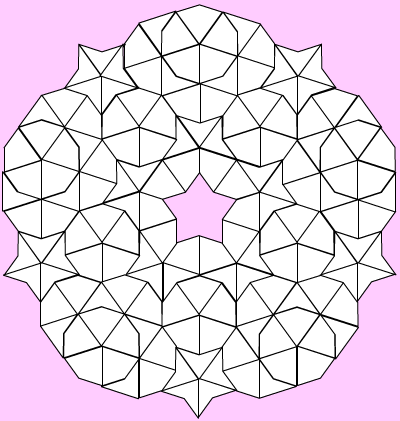
One living mathematician who has done a lot of work in this
area is Roger Penrose. He has explored tiling patterns that
cover the whole plain like a tessellation but are not regular
in the way in which the pattern repeats itself. His designs are
stunning in their beauty and underlying simplicity, and we have
developed one of them into an interactive activity called
"
Building
Stars ".
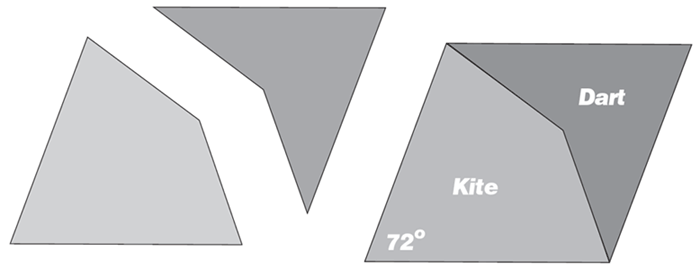
This design uses two quadrilateral shapes -a kite and a dart
-and they are repeated over and over again but do not fit
together in a regular way. As well as exploring this pattern
interactively on the website you could also use the templates
to create your own kites and darts either cut out in sticky
paper or in sponge so that you could print a pattern using the
shapes.
One of the key features of the kites and darts that are used in
this pattern is the ratio between the lengths of the sides,
which is the Golden Ratio. Investigating the importance of this
number in art and architecture as well as more mundane things
like the shape of A4 sheets of paper is yet another fruitful
avenue of mathematical study and once again it links to many
different curriculum areas.
The mention of architecture takes us into Islamic art, of which
decorative patterns are a central feature owing to the
prohibition of representation of natural forms in Islam. As is
often the case with constraints of one kind or another, this
restriction has led Islamic artists to become masters of
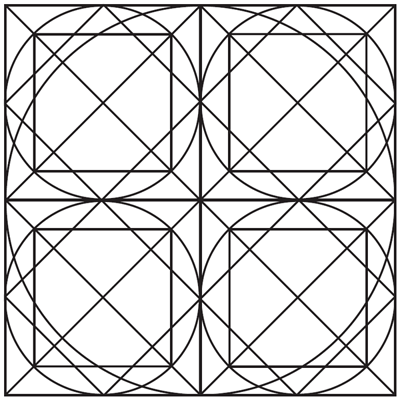
abstract geometrical patterns and tilings. One frequently used
tiling is a stars and crosses design which can be constructed
using a ruler and a pair of compasses.
The template, below, can also be found
here
in the form of an interactive game to play with the pattern.
Constructing the pattern oneself is quite a challenge even for
the highest attainers.
Spirals
Another kind of pattern that is found in art and that has
mathematical significance is the spiral. In fact, there are
many different spirals and they arise out of different
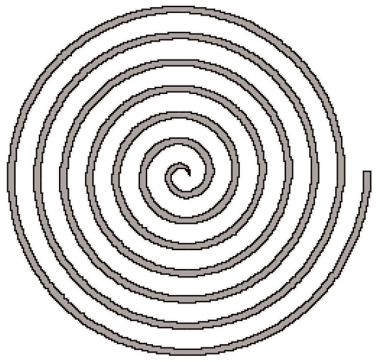
contexts. Archimedes, the Greek mathematician, has one named
after him which can be constructed using a cotton reel, strip
of paper and a pencil and looks like the pattern below: it is
the path followed by an object travelling away from a given
point at constant velocity.
Of course there are also spirals all around us - from screws to
the pattern of segments in a pineapple, or the way leaves are
spiralled round the stem of a plant. Did you even make
twizzlers as a child? Draw a spiral on each side of a circular
piece of card, make two holes either side of the centre and
thread a length of string through them. Tie it to make a loop,
keeping the card in the middle, twist both ends and then pull.
The twizzler will work and you can experiment to see what
visual effects can be made. Make links to colour mixing too, by
colouring the spirals in different colours.
Teddy Town
What other connections can we make with mathematics across the
curriculum? One approach to teaching maths that I and many
others find useful is to contextualise it within a story, and
there are many stories that we can tell that have mathematics
in them. One of my favourites is a story about "
Teddy
Town " where different bears of different colours live in
different streets. It offers a context for an interesting
problem about shape, space and combinations.
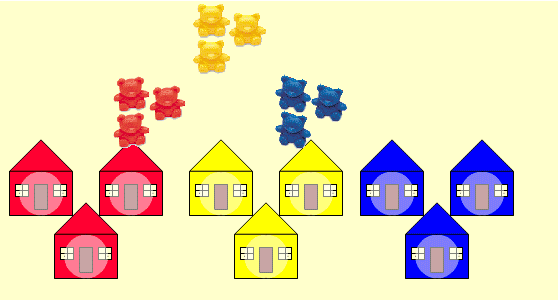
In Teddy Town, teddies are either red, yellow or blue and they
live in red, yellow or blue houses. There are nine teddies -
three red, three yellow, three blue - and nine houses - three
red, three yellow and three blue.
What are the nine different combinations of teddies and houses?
Here is a map showing Teddy Town:
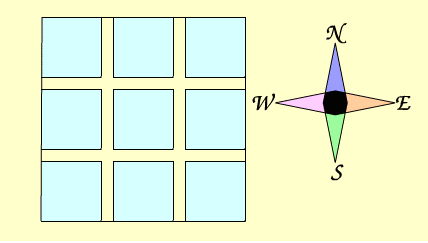
The streets are very special. If you walk along a street from
east to west, or west to east, all the houses are a different
pattern and the teddies living in the houses are a different
pattern too. The same is true if you walk along the streets in
a north-south or south-north direction.
In other words, looking at the map grid, each row and column
must have different patterned houses and different patterned
teddies.
Can you arrange the nine different combinations you've found on
the map grid?
There are plenty of other stories that you may be familiar with
that have mathematics in them. For example, Eric Carle's
picture books such as The
Very Hungry Caterpillar and The Bad Tempered Ladybird , which
can help to introduce young children to counting and the
concept of time on the clock. For older children, Hans
Ensenberger's The Number
Devil is a delightful story that describes a young boy
dreaming about numbers which he is introduced to by the Number
Devil. It includes all sorts of different numbers from
Fibonacci numbers to triangle numbers and prime numbers, with a
chapter on each. Wouldn't it be refreshing to have a shared
reading of a mathematics book for a change?
A couple of years ago I was involved in a project in Lewisham
in which I worked with an expert Theatre in Education team
called
Make Believe
Arts to develop some mathematical stories that had maths
built into them as part of the story itself. The children acted
out the stories and in each case a particular mathematical
problem had to be resolved in order for the story to progress.
It was tremendous fun and proved a memorable experience for the
children. A traditional story that is similar is an Indian tale
called
Sissa's Reward :
According to an old Indian myth, Sissa ben Dahir was a courtier
for a king. Sissa worked very hard and invented a game which
was played on a board, similar to chess. The king decided to
reward Sissa for his dedication and asked what he would like.
Sissa thought carefully and then said, "I would like one grain
of rice to be put on the first square of my board, two on the
second square, four on the third square, eight on the fourth
and so on." The king thought this was a silly request, but
little did he know...
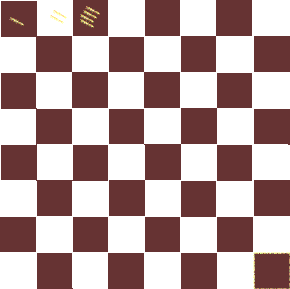
Left is a chess board with the first few squares filled with
grains of rice as Sissa asked for.
- How many grains of rice would there be on the eighth
square?
- How many grains would you need altogether in order to fill
up to the 15th square?
- Estimate how many grains you would need in total to fill
the entire board in this way. Explain your thinking.
- Perhaps Sissa was cleverer than the king thought!
Egyptian maths
I have already mentioned quite a few mathematicians of
historical significance and the connections between maths and
history are very strong and well worth investigating. There is
the history of mathematics itself, which is fascinating in its
own right. It is hard to imagine how the Romans did arithmetic
when one looks at their number system, and the development of
our own conventions are fascinating. How did they manage
without a symbol for zero for so long? Delving back into
ancient history, the Egyptians were brilliant at geometry and
their methods helped them to construct the Pyramids, but what
about fractions? They had an interesting method which only
allowed them to express fractions as unit fractions with one as
the numerator. Expressing fractions as the sum of unit
fractions is tricky but is an interesting mathematical problem:
This problem can be found on the website
here
.
Did you know that the Egyptians wrote all their fractions using
what we call unit fractions? A unit fraction has 1 as its
numerator (top number). Here are some examples:
1/5 1/3 1/2
They expressed all fractions as the sum of unit
fractions, but they weren't allowed to repeat the same unit
fraction in the addition. So we couldn't write:
3/8=1/8+1/8+1/8
because we've used 1/8 three times. However, this would be fine:
3/8=1/4+1/8
How could the Egyptians write 3/4? Are there any other ways?
What is 2/3 written as the sum of unit fractions? Again, investigate different ways of doing this.
Find some more fractions (say three or four) which you can write as the sum of unit fractions.
Fibonacci
What about the great mathematicians? I have already mentioned
Archimedes but there are so many others: Pythagoras, Escher,
Euler and of course Fibonacci. St Andrew's University in
Scotland has a website dedicated to the history of mathematics
and it is possible to find a different mathematician for every
day of the year there. There are a number of sources of
information on the web about Fibonacci but one of the best must
be that developed by an enthusiast,
Ron Knott . He
offers enough ideas to fill your maths lessons for weeks
as well as your history, science and art lessons! There
are lesson ideas, challenging questions and links to other
websites galore. Here is a sample:
Fibonacci's Rabbits
The original problem that Fibonacci investigated (in the year
1202) was about how fast rabbits could breed in ideal
circumstances.
Suppose a newly-born pair of rabbits, one male, one female, are
put in a field. Rabbits are able to mate at the age of one
month so that at the end of its second month a female can
produce another pair of rabbits. Suppose that our rabbits never
die and that the female always produces one new pair (one male,
one female) every month from the second month on. The puzzle
that Fibonacci posed was:
How many pairs will there be in one year?
- At the end of the first month, they mate, but there is
still only one pair.
- At the end of the second month the female produces a new
pair, so now there are two pairs of rabbits in the field.
- At the end of the third month, the original female produces
a second pair, making three pairs in all in the field.
- At the end of the fourth month, the original female has
produced yet another new pair, the female born two months ago
produces her first pair also, making five pairs.
The number of pairs of rabbits in the field at the start of
each month is 1, 1, 2, 3, 5, 8, 13, 21, 34...
Can you see how the series is formed and how it continues?
The Fibonacci connection brings me more or less to the end of
this article, although I have only scratched the surface of the
possibilities for linking maths with other curriculum areas in
exciting and challenging ways. I haven't even mentioned
geography, with maps, bearings, contours just as starters, or
physics, where we could explore speed, time, rates of change,
measurement and a host of other things. I will leave those for
another time. The creative possibilities are endless and are a
fruitful field for exploring.
Bibliography
Carle, Eric (1982) The
Bad-Tempered Ladybird . Picture Puffins, London. ISBN
0140503986
Carle, Eric (1970) The Very
Hungry Caterpillar . Hamish Hamilton, London. ISBN
024101798X Enzensberger, Hans Magnus (2000) The Number Devil: A Mathematical
Adventure . Henry Holt & Company. ISBN 0805062998
This article first appeared in Maths Coordinator's File issue
19, published by pfp publishing. To find out how to subscribe
to the Maths Coordinator's File, click
here .