Complex numbers can be a difficult topic to break into.
Understanding them often involves accepting what may seem to be
arbitrary rules about a meaningless idea. Only later do the rules
make sense and the meaning, applications and connections to other
areas of Maths and Physics become obvious.
The aim of the "Arrow Arithmetic" and "Twizzles" exercises is to
introduce complex numbers in a new way - as an extension of real
numbers, following on from them more naturally than in the
conventional approach.
Exploring the Number Line
Instead of plunging straight into complex numbers, the problems
begin by taking a fresh look at real numbers - numbers on the
number line - and their arithmetic. Numbers are represented by
a pair of arrows - one wider and one narrower - described as
twizzles. The wider arrow is the unit arrow which defines the
scale. The value of the twizzle is given by the length of the
narrower number arrow and its direction - in the same direction
as the unit arrow for positive numbers and in the opposite
direction for negative numbers. For example, the twizzle below
represents the number two because its number arrow is twice as
long as its unit arrow and points in the same direction.

Figure 1
The interactive animations allow you to manipulate the arrows
by changing their values, moving them around the screen,
stretching them and separating the unit from the number arrows.
To get a handle on their behaviour you could also make
real-life twizzles to manipulate, using strips of elastic band.
Each strip needs three marks on it: one for the origin (the
pink spot in the diagram above), one for the head of the unit
arrow and the third for the head of the number arrow. You can
try the Arrow Arithmethic exercises using elastic twizzles as
well as the virtual ones in the animations.
Twizzles can be used to do arithmetic geometrically, with
arrows representing steps along the number line. The simplest
example is addition. To add twizzles, they are first scaled so
that their unit arrows all have the same length and direction.
The number arrows are then arranged nose-to-tail. The twizzle
representing the sum has a unit arrow of the same size and
direction as the original unit arrows and and a number arrow
streching from the tail of the first number arrow to the head
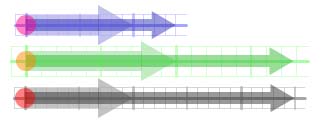
of the last. In Figure 2, the blue and green number arrows have
been added together to give the grey. Below the number arrows
are the unit arrows, lined up to show their matching size and
direction.
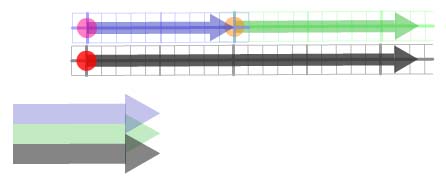
Figure 2
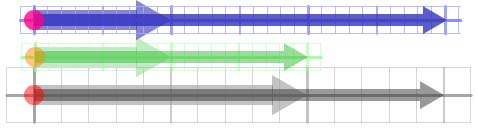
In Figure 3, the green twizzle has been subtracted
from the blue one to give the grey. Because subtraction is just
addition of a negative number, the rule for twizzle subtraction is
similar to addition, except that we must start by rotating the
green twizzle through 1800 to make it negative relative to the blue
unit arrow. The twizzles are then added nose-to-tail as before.
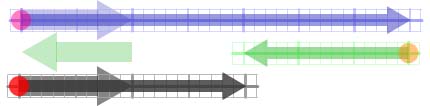
Figure 3
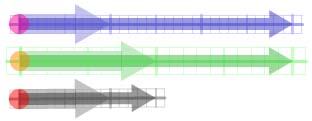
Multiplication is a little different. Figure 4 shows an
example, where the blue and green twizzles are multiplied to
give the grey twizzle. First we adjust the length and direction
of the green unit arrow until they are the same as those of the
blue number arrow. The other two arrows (the unit arrow from
the blue twizzle and the number arrow from the green) make up
the grey twizzle representing the product. We could have got
the same answer by matching the lengths of the blue unit arrow
and the green number arrow, in which case the product would
have been represented by the remaining two arrows.
Figure 4
Dividing by a number means multiplying by its reciprocal (one
divided by the number), and to find the reciprocal of a twizzle
you swap the lengths of its arrows. So Figure 5a shows how the
blue twizzle is divided by the green: the roles of the arrows
in the green twizzle have been exchanged so this time we match
the sizes of the number arrows and the two unit arrows make up
the twizzle for the answer. Because we matched the number
arrows, the unit arrow of the blue twizzle becomes the unit
arrow in the result and the unit arrow of the green twizzle
becomes the number arrow in the result. We could also have got
the answer by matching the unit arrows (Figure 5b), but we
would have had to take the green number arrow for the grey unit
arrow and the blue number arrow for the grey number arrow.
Figure 5a
Figure 5b
New Directions
The twizzles we have looked at so far have arrows pointing in
the same or in opposite directions and can represent any number
on the number line. What about twizzles whose arrows point in
completely different directions? These represent numbers not on
the number line - complex numbers. Twizzles can be used to
think about what complex numbers are and how they behave.
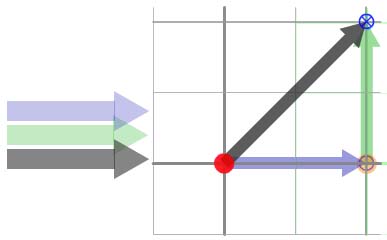
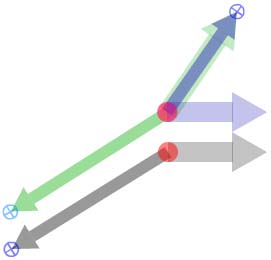
Let's add two twizzles. In
the diagram below, the blue twizzle has its arrows parallel in the
way we've met before. It represents the number 1. The green twizzle
has its arrows at 900and length 1 so that following the
number arrow would not move us along the number line at all but one
unit at right angles to it. The sum of the blue and green twizzles
(the grey twizzle) can be constructed using the rule for twizzle
addition. As shown, it turns out to have length Ö2 (using
Pythagoras) and be orientated at 450 to the unit arrows.
Figure 6
Now a multiplication. In Figure 7, the blue and green arrows
have been multiplied together as before, by matching the
lengths and directions of one unit arrow and one number arrow.
The grey twizzle gives the result: a unit arrow from the blue
twizzle and a number arrow from the green one. The size of the
grey twizzle (the length of its number arrow in units of its
unit arrow) is the product of the values of the green and blue
twizzles. The angle between its arrows is the angle of the blue
twizzle plus the angle of the green twizzle (measuring all
angles anti-clockwise from unit to number arrow).
Figure 7
Getting More Complex
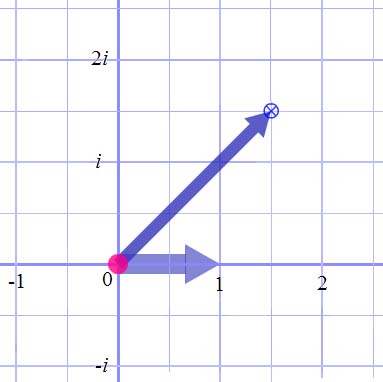
How should we describe the numbers whose twizzle arrows point
in different directions? Conventionally, we start by arranging them
on a diagram called an Argand diagram, like the one in Figure 8.
The tails of both twizzle arrows are placed at the origin, and the
twizzle is adjusted so that the head of the unit arrow is at one on
the horizontal axis. The head of the number arrow now indicates a
point which represents the twizzle on the diagram.Figure 8 shows
how the number 1.5+1.5i is represented.
Figure 8
Numbers on the number line have twizzles whose arrows both
point in the same direction, so these all sit on the horizontal
axis in the Argand diagram. These numbers are called real numbers
and the horizontal axis, which is really just the number line, and
is called the real axis. Numbers sitting on the vertical axis
aren't real, so instead of labelling it with the real numbers we
label it i, 2i, 3i, etc. where i, which stands for imaginary, tells
us that these numbers are on the vertical, imaginary axis instead
of the number line. So a point on the positive vertical axis one
unit from the origin represents a number called i whose twizzle is
two arrows of equal length pointing at 900 to each other, measuring
anti-clockwise from unit to number arrow.
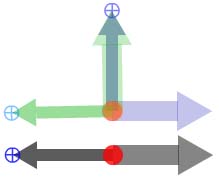
What is the number i? We use twizzles to multiply i by itself.
The blue and green twizzles both represent i, and the grey twizzle
is their product.
Figure 9
So i2=-1, or in other words, i is a square root of -1. From our
experience of the real numbers, numbers have two square roots. So
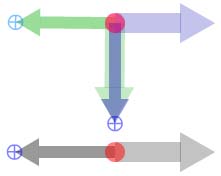
what is the other root of -1? What other twizzle can be multiplied
by itself to give -1?
Figure 10
The numbers i and -i are the square roots of -1. And in the
same way, 2i and -2i are the roots of -4, 3i and -3i are the roots
of -9, and so on.
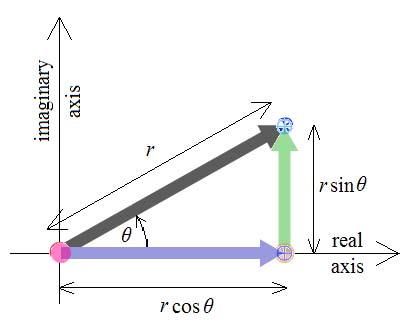
What complex number does
an arbitrary twizzle represent? Take a twizzle whose length is r
times the length of its unit arrow, with an angle q between its arrows. We can construct any
twizzle from the sum of a purely real number, a, and a purely
imaginary one, b ×i, as shown (Figure 11). The blue arrow has lengtha and the green arrow has length b. Basic
trigonometry gives the sizes of these real and imaginary numbers
and we can write our complex number, z, as:
|
z = a + bi = r(cos q+ i sin q) |
|
Figure 11
A complex number can be described in two ways: by the
purely real and imaginary numbers a and bi of which it is the sum,
or by its modulus (length), r, and argument (angle to the real
axis), q. It turns out that (cos q+ i sin q)
is equal to ei q as long as q is in radians, not degrees. So another
way of writing the number represented by our arbitrary twizzle
would be z = rei q.
When adding and
subtracting complex numbers, the a+bi form is helpful because we
can add or subtract the real parts of the two numbers separately
from the imaginary parts. For example,
|
(a+bi) + (c-di) = (a+c) + (b-d)i |
|
This makes sense when we think of the twizzles on the Argand
diagram. The distance by which the ''sum'' twizzle moves us along an
axis is the sum of the distances each twizzle would move us on its
own.
For multiplying complex numbers, the
rei q form is more helpful because we can
deal with the size and direction parts of the twizzles separately.
For example,
|
rei q×sei f = (rs)ei(q+f) |
|
This makes sense
because, as we saw in Figure 7, the length of a product twizzle is
the product of the lengths of the factor twizzles and the angle is
the sum of the angles. To divide complex numbers, you would divide
the moduli and subtract the arguments.
Complex Numbers Reach Places other Numbers don't Reach
Think about the equation x2-2x+10 = 0.
Using the formula for solving quadratic equations gives us the
solutions
Before we knew about complex
numbers, we might have said that the equation had no roots, but now
we know that this is not true. It has no real roots, but it does
have two complex roots, at x = 1+3i and x = 1-3i. Complex numbers
have allowed us to answer a previously unanswerable question.
Now try x3 = -1. The real numbers give us one solution: x = -1.
But what if we use the rei q notation? The modulus of -1 is 1,
and we can say that the argument is pradians (1800), but if the argument
were 3 p, 5 p, 7 p and so on, the twizzle would still look the same.
Adding 2p radians to the argument of a complex number leaves it unchanged.
So, writing the equation again, expressing x as reiq,
|
r3e3iq = eip = e3ip = e5ip = e7ip = etc. |
|
and the solutions are r = 1 with
q = p/3, p, 5p/3, 7p/3, etc . Discarding the ones
which are the same as others by the ''adding-2p'' rule
leaves three solutions:
|
x = ei p/3 x = ei p x = e5ip/3 |
|
The second of these is -1, which we already knew about, but the other two
are both complex. Once again, complex numbers have provided solutions we never knew existed.
We have just
uncovered a whole extra world of numbers. Might there be any more?
In fact, you can find all the roots of any polynomial equation
using just the complex numbers, a result known as the Fundamental
Theorem of Algebra.
Why Complex Numbers?
You can't have i apples in
a basket, or take £(7+5i) out of a cash machine, or
travel at
miles per hour, so why bother with complex
numbers? Are they just an intriguing mathematical phenomenon with
no practical meaning or use? The answer, of course, is no: complex
numbers are essential in Physics as the tools for describing
oscillating quantities: atoms vibrating in their molecules, the
swing of a pendulum or light waves travelling through space.
Complex numbers can also be used to think about geomety on a flat
piece of paper because they correspond to points on the Argand
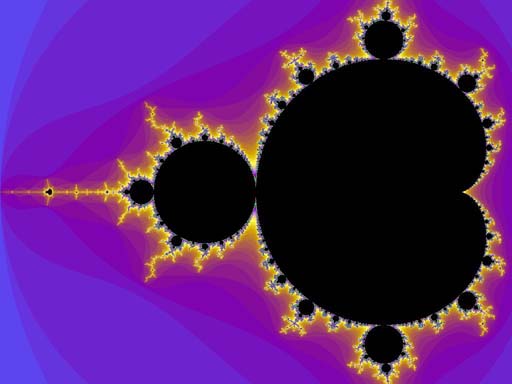
diagram. A famous example is the Mandlebrot set (Figure 12). The
well-known image is in fact an Argand diagram, where the points
coloured black correspond to the complex numbers c for which the
series zn+1 = zn2 + c doesn't tend to infinity.
Figure 12
Transformations of points are equivalent to
operations on complex numbers. For example, translating a point a
units in the x-direction and b units in the y-direction means
adding (a+bi), and rotating 900 anticlockwise about the origin
corresponds to multiplying by i (to see this, think of doing the
arithmetic using twizzles). There are much more complicated
transformations, too, with all sorts of interesting properties, and
applications from drawing the field lines from an electric charge
to pinpointing the source of an earthquake based on measurements
made all round the globe.
Some Further Reading
For more information on topics skimmed over here, try these:
- For an intuitive proof of the fundamental theorem of
algebra without lots of mathematical jargon and notation, see
p38 of A Mathematical
Bridge by Stephen Hewson, published by World
Scientific.
- Plex
and Plex2
let you experiment with graphical representations of functions
of complex numbers.
- One of the geometrical transformations you can perform
using complex numbers, which is used for locating earthquakes,
is a stereographic projection. There's an animation, and some
description in words here .
- NRICH has two other articles on Complex numbers. What are
Complex Numbers? gives a sense of where complex numbers fit
into the bigger picture by bringing in related topics, such as
trigonometry, exponential functions and vectors. It also proves
that the exponential and trigonometric expressions for a
complex number are equivalent. An
Introduction to Complex Numbers goes into more mathematical
detail, and includes exercises.
- There's lots on the internet about the Mandlebrot set,
which you can easily find using Google. Wikipedia has
some particularly beautiful pictures. There's an applet for
exploring the Mandlebrot set here
, with a link to some explanation
.