When we think of negative numbers, they seem perfectly natural to
us. That's because we've been taught to see numbers as a
continuous number line, stretching out from zero in both the
positive and negative directions. To us, -3 is just as real as +3
is, but this was not always the case. Negative numbers have only
fairly recently become accepted as part of the system of numbers
that mathematicians are allowed to use. While a great deal of
very advanced maths was developed by ancient civilisations,
mathematicians in most cultures had no understanding of what a
negative number could mean. In this article we're going to
explore some of the earliest appearances of negative numbers and
how attitudes towards them have changed over the centuries.
Among the earliest people to use negative numbers in calculations
were the ancient Chinese. They used counting rods to perform
calculations, with red rods for positive numbers and black rods
for negative numbers. The example below shows some Chinese
numerals represented by rods, and the diagram on the right shows
which numbers these symbols represent.
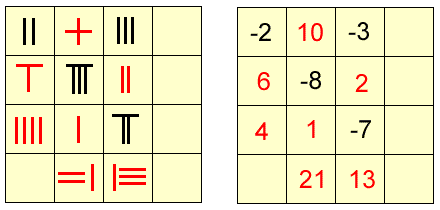
Using this system, Chinese mathematicians were able to solve
simultaneous equations. Reading the numbers from top to bottom,
the grid above actually represents the set of equations that we
would write as:
-2x+6y+4z=0 10x-8y+z=21 -3x+2y-7z=13
Indian mathematicians also used negative numbers long before
Western civilisations. An ancient manuscript from 200 BC shows
that they used to use the + sign that we now associate with
addition and positive numbers, to denote a negative number.
Although negative numbers were used in calculations, negative
answers to mathematical problems were usually considered
meaningless and were discarded.
The ancient Greeks also dismissed any solutions to equations
that came out negative. They called them "absurd" and
"impossible" and completely ignored them. They couldn't see how
a negative answer could be meaningful, because it was not
possible to have a quantity that was less than nothing . This opinion
was passed down to later mathematicians in Europe for more than
a thousand years, so very little progress in negative number
arithmetic was made for a long time.
Can you think of something in the real world where you can have
a negative quantity that actually means something? Today we are
quite familiar with the idea of somebody being in debt and
therefore having a negative amount of money. It means that they
have no money in their possession, and actually owe someone
else money as well. It's not a very nice position to be in, but
debt is a form of negative quantity that has been around for
thousands of years. In fact calculations involving money were
the only ones that were allowed to have negative answers, but
most mathematicians weren't interested in that kind of problem.
So, even though everyone was quite happy to allow subtraction,
and could understand the notion of debt, it took centuries before
mathematicians understood or accepted that negative numbers could
exist as genuine numbers in their own right. In 1759 Francis
Meseres wrote that negative numbers:
"darken the very whole
doctrines of the equations and to make dark of the things which
are in their nature excessively obvious and simple. It would have
been desirable in consequence that the negative roots were never
allowed in algebra or that they were discarded" .
Even as late as 1803 the famous French mathematician Carnot was
worried about the reality of negative numbers:
"to really obtain an isolated
negative quantity, it would be necessary to cut off an effective
quantity from zero, to remove something of nothing: impossible
operation. How thus to conceive an isolated negative
quantity?"
Some mathematicians in the 17th century discovered that negative
numbers did have their uses. Provided they didn't worry about
what negative numbers meant, and more particularly what the
square roots of negative numbers meant, they found that they
could solve some very tricky equations, like cubic and quartic
equations. What's more, although the intermediate steps of a
calculation may have involved negative numbers, the solution
often came out as a real, positive number which was exactly what
they wanted.
Since then mathematicians and scientists have found all sorts of
uses for negative numbers. We now recognise that in many cases a
negative answer can be a real, meaningful solution, but one that
indicates direction .
For instance, if I wanted to calculate how many steps forward
Robert has taken, and the answer is -5, then it means he has
taken 5 steps backwards. The first person to recognise the link
between negative numbers and direction was John Wallis, a
mathematician in the 17th century. He was the first to come up
with the idea of a number line as a geometrical representation of
the number system. Confusingly however, he also thought that
negative numbers were larger than infinity!
Nowadays we use negative numbers just like any other
numbers without even a second thought. Their troubled history
shows how the simple mathematical principles we take for granted
have taken thousands of years to develop. Physical meaning has
given way to algebraic utility, but negative numbers and their
derivatives have turned out to have all kinds of practical
applications. Take the square root of -1 for example - it seems
meaningless in itself, but many calculations in science and
engineering wouldn't be possible without it.
