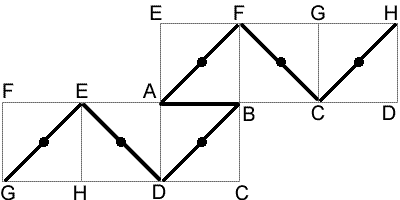
The image above shows a possible path. Each edge joining a corner to a face
centre has length
(by Pythagoras' Theorem), while each
edge which joins two adjacent corners has length 1. So the length of the path
above is
. This is the length of the shortest path to pass through
all the vertices. To prove this, note the length of the shortest path must be at least
.
Such a path would move alternately between corners and faces, but as there are
8 corners and only 6 faces, so this is impossible. So at least one of the edges
must join to corners, and so the shortest length is
.