This problem builds on
Consecutive Sums and invites you to explore how algebra can
help with proof. If you are not familiar with the problem it
would be good to look at that first.
12 can be made as a sum of consecutive numbers: 3 + 4 + 5.
15 can also be made as a sum of consecutive numbers in several
ways, for example 7 + 8.
At first it seems that maybe any total could be made as a sum
of consecutive numbers. However, after trying several
possibilities, it doesn't seem as though we can make 16 in this
way.
Every total from 17 to 31 can be made as a sum of consecutive
numbers, until we reach 32.
Let's use algebra to explore why that is.
First : what is the sum of 7 consecutive numbers starting with
4?
There is a quick way to calculate consecutive sums. Do you know
it?
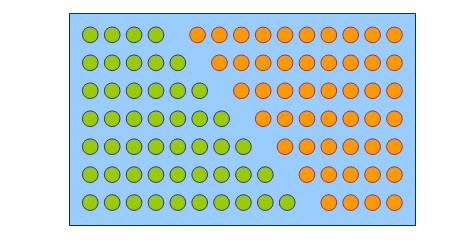
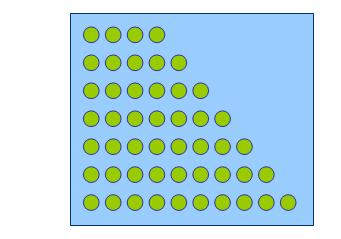
Take a look at the next image.
Take the set to be counted twice, the second time inverted. So the sum here
| 4+5+6+7+8+9+10 = |
1
2
|
×(4+10) ×7
|
Can you use this method to find the sum of 8 consecutive
numbers starting at10 ?
Here's a much longer run of consecutive numbers, can you find its
sum : 10, 11, 12, . . . . . . . . . 79, 80?
What is the sum of n consecutive numbers starting at s ?
This might help you to use algebra to reason why 16 and 32 are
impossible to create as the sum of consecutive numbers.
Can you make a general statement about numbers of that sort
(powers of 2)?
Note:
Why 24
? is another problem where reasoning from algebra proves to
be very powerful.