How curved is a curve? How curved is a surface? When is a 'curved
surface' flat? We shall only briefly mention curves in the plane
and then move on to discuss positive and negative curvature of
surfaces.
Imagine tracing out the ellipse shown in the diagram. How does
the curvature change as you go around the ellipse? Without
applying any mathematics everyone would agree that the tightest
bends are at the ends and the least curvature on the track around
the ellipse is halfway between these points .
To measure the curvature at a point you have to find the circle
of best fit at that point. This is called the osculating
(kissing) circle. The curvature of the curve at that point is
defined to be the reciprocal of the radius of the osculating
circle. We shall not discuss in this article the method for
finding this radius accurately which needs calculus. Suffice it
to say that this circle has not only the same tangent at the
point (the first derivatives being the same) but also the curve
and the osculating circle have the same second derivatives at the
point.
Why use the reciprocal in defining curvature? It is natural for
the curvature of a straight line to be zero. Imagine
straightening out a curve making it into a straight line. In the
limit the circle of best fit has infinite radius giving zero
curvature.
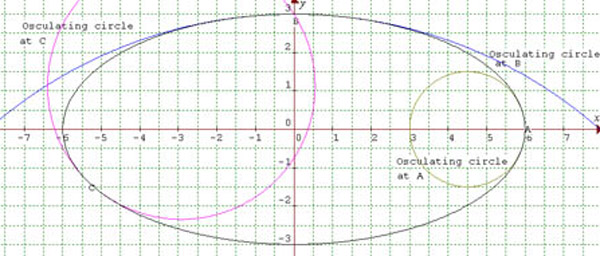 |
The diagram shows
osculating circles
to the ellipse at
points A, B and C.
At A the curvature
is
,
at B it is
and at C it is
.
|
The following equations are given in case you want to plot the graphs
yourself, but ignore them if not and read on.
The equation of this ellipse is
At the point on the ellipse
with
, the curvature is given by
|
|
 |
 |
A perfect sphere has constant curvature everywhere on
the surface whereas the curvature on other surfaces is
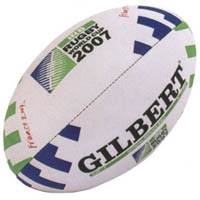
variable. For example on a rubgy ball the curvature is
greatest at the ends and least in the middle. Measuring
curvature at a point using curves through that point on
the surface will not work. Which plane curve should we
use? At the '2' on the rugby ball, the curve in one
direction, going between the B and the E, has greater
curvature than the curve along the length of the ball.
Gauss proved that, taking the curvatures in all
directions at a point on a surface, the product of the
maximum and minimum curvatures at the point is constant
when the surface is distorted provided that lengths in
the surface are unchanged.
|
One method used to measure the Gaussian curvature of a surface at a point
is to take a small circle of radius
on the surface with centre at that
point and to calculate the circumference or area of the circle. If the
circumference is
and the area is
the surface is flat and is
said to have zero curvature. If the circumference is less than
and the
area is less than
the surface has positive curvature;
if the circumference is greater than
and the area is greater than
the surface has negative curvature.
There are three distinct geometries for the three types of surfaces and each
of these geometries has its own trigonometry with the results in each
trigonometry having counterparts in the other two trigonometries. Euclidean
geometry is the geometry of surfaces with zero curvature. Spherical geometry,
also known as elliptic geometry, is the geometry of surfaces with positive
curvature. Hyperbolic geometry is the geometry of surfaces with negative
curvature. See the article
How Many Geometries Are There?
.
|
What about the curvature of the surface of a cylinder.
Clearly the top and bottom are flat but what about the
surface, often called the curved surface, where the label
is wrapped around as in the illustration? Along the length
of the cylinder the curvature is zero and in other directions
there is positive curvature so the product of the maximum
and minimum curvatures is zero making the Gaussian
curvature zero. To see this another way, unwrap the label
and you can flatten it out,
draw a small circle of radius
anywhere on the label
and it has a circumference of
and an area of
Wrap the label around
the can again and the circumference and area of the circle
you have drawn do not change as the paper takes the shape
of the surface of the cylinder. So the surface of the
cylinder has zero Gaussian curvature.
|
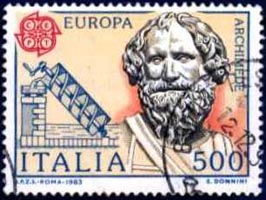 |
In order to find the areas of circles on spheres we
shall use a result discovered by Archimedes of Syracuse
who invented calculus type methods almost two thousand
years before Newton and Leibniz. Archimedes made many
discoveries and inventions including the Archimedean
Screw pump, still in use today, depicted on this stamp,
and you can find out more about him on the
St Andrew's website. The result we shall use is
depicted in the diagram on the right and said to have
been on Archimede's tombstone.
|
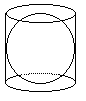 |
The cylinder shown has radius
, height
and area
,
the same as the surface area of the
sphere inside. Moreover the area of a
strip on the surface of a sphere cut off
by two parallel planes is equal to the area
cut off by the planes on the circumscribing
cylinder.
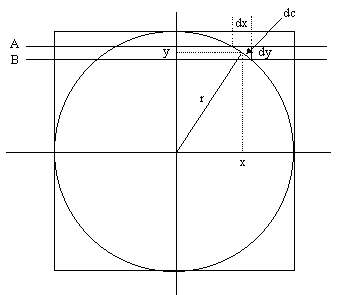
In this cross section, A and B
are planes at a small distance
dy apart, cutting the sphere and
circumscribing cylinder. The
'triangle' with sides dy, dx and dc
is so small that we can treat the
arc dc as if it were a straight
line and the hypotenuse of this
triangle. This tiny triangle is
similar to the triangle shown
with sides
and
so that
The area of the strip cut off by
planes A and B on the surface of
the sphere is
because
this strip has circumference
and height dc.
The area of the band on
the cylinder is
.
As we have shown that
it follows that these areas are
equal.
|
 |
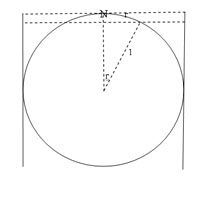 |
Now we study the curvature of the surface of a
sphere of unit radius. Take any point N and draw a
circle centre N radius
on the surface of the sphere
where the radius is an arc in the surface of the sphere
subtending an angle of
radians at the centre of the
sphere.
The circumference of the circle centre N radius
is
. Because
for all
non-zero values of
we see that this circumference
is less that
showing that the surface has positive curvature..
By Archimedes' method the area of this circle is
You can verify that this is
less than
, and hence that the curvature
of the surface of the sphere is positive, by drawing the
graphs of
and
on
the same axes and showing that
|
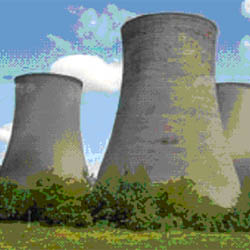
It is harder to model surfaces of negative curvature like a
saddle between two hills, the surfaces of cooling towers,
banana skins etc.A banana has positive curvature on the outside
of the 'bend' of the banana and negative curvature on the
inside.
Imagine you are at the lowest point on the saddle between the
two hills shown in the picture below.
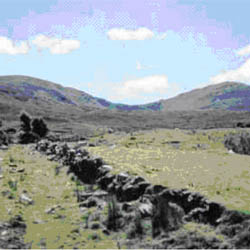 |
Tie a long rope to a post at this point and, keeping
the rope taught, walk around a circle with the post as
centre. As you have to walk uphill and downhill as well
as around the post you walk farther than you would walk
on flat ground showing that the curvature at that point
is negative.
|
 |
Gaussian curvature is closely linked to the angle deficiency of
the surface at that point. If the surface is flat and you draw
a circle centred at that point you go around 360 degrees.
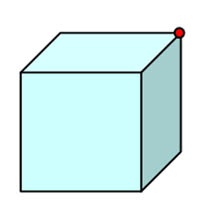
At the red spot on the cube the angle deficiency
is
, the circumference of a
circle of radius
with centre at the red spot
on the cube is
so the curvature at that point is positive. The
curvature is concentrated at the vertices of
the cube rather than being distributed over
the surface as with a sphere or a rugby ball
shaped solid.
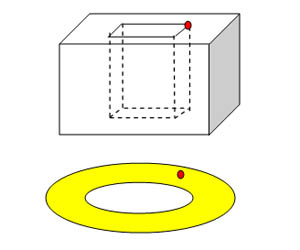
Although the curvature is concentrated at 16
points, the block shown with a hole through it
is analagous to the torus (or doughnut
shaped solid) shown in yellow.
 |
We investigate the curvature at the red spot
at the edge of the hole in the block. The angle
deficiency at the red spot is
.
The circumference of a circle of
radius
with centre at the red spot
on the block is
so the curvature at that point is negative.
|
 |
You can check for yourself the property (equivalent to Euler's
formula) that the total angle deficiency for any polyhedron is
720 degrees. The total angle deficiency for a solid depends on
the number of holes in the solid. For solids with one hole the
total angle deficiency is zero.
To read more on the subject of Gaussian curvature without getting
deep into higher mathematics see
this article and related articles from a workshp on 'Geometry
and The Imagination' led by John Conway, Peter Doyle, Jane Gilman
and Bill Thurston.