Simon from Elizabeth College, Guernsey and Andrei from Tudor Vianu National College, Romania have both solved this problem and both solutions are used below.
![]() |
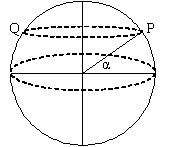
To solve this problem we shall consider that the point
is situated at latitude $\alpha$. To travel around the
line of latitude, the distance from P to Q would be
half the circumference of the circle at latitude
$\alpha$. This circle has a radius $R \cos \alpha$,
where $R$ is the radius of Earth.
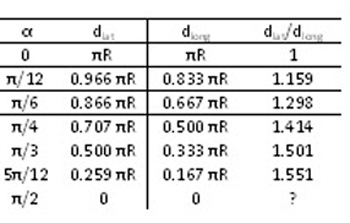
So, the distance traveled from P to Q on the line of
latitude is $d_{lat} = \pi R \cos \alpha$.
|
| Traveling over the line of longitude, the circle on which we have to calculate the distance is a great circle of the sphere, and the angle of displacement is radians. The distance is therefore where is the angle of latitude in degrees or equivalently . It is clear that the path on a great circle is always shorter. | ![]() |
![]() |
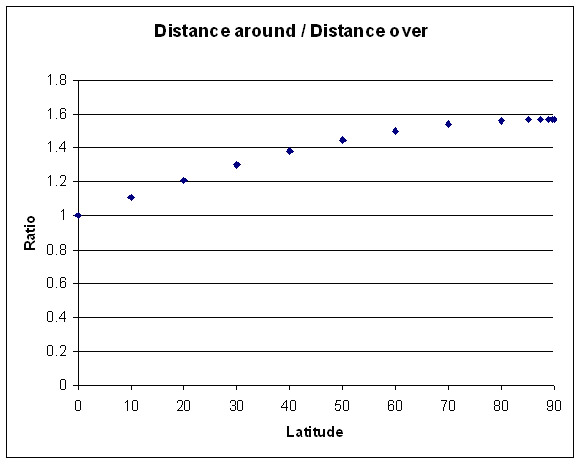
A graph of the ratio of these distances
shows that this ratio seems to tend to
as the line of latitude approaches
the pole, that is the ratio
tends to a limit as . This ratio can also be written as As we know as we can take and we see that this limit is . |