Well done Rhema from Crown Woods School,
Simon from Elizabeth College, Guernsey,Trevor from Queen
Elizabeth's School, Barnet and Andrei from Tudor Vianu National
College, Bucharest, Romania, you all sent in good solutions. To
find the solution as a numerical approximation, Andrei used
interval halving and a graphical method, Trevor and Simon used
the Newton-Raphson method, Trevor used a spreadsheet for the
calculations and Simon wrote a program in C to do the
calculations.
Case (i)
If $a = b$ the equation $a^x + b^x = 1$ where $0< a, b < 1$
and $a + b < 1$ becomes $2a^x =1 $. Then $\log 2 + x \log a =
0$ so the solution can be given in three equivalent forms: $$x =
{-\log 2 \over \log a} = {\log 0.5 \over \log a } = {\log 2 \over
\log 1/a}.$$ Note we can use natural logarithms here or
logarithms to any base.
Case (ii)
Solve $a^x + b^x = 1$, where $a=1/2$ and $b=1/4$. The equation
is: $$(1/2)^x + (1/4)^x = 1,$$ Here you could substitute $y =
(1/2)^x$ but Trevor multiplied by $4^x$ and used the substitution
$y = 2^x$. By Trevor's method: $$4^x/2^x + 1 = 4^x$$ So $$2^x + 1
= (2^x)^2.$$ and the equation becomes: $y + 1= y^2$ or $y^2- y- 1
= 0$. Using the quadratic formula, the negative solution to the
quadratic can be ignored as $2^x$ is never negative, so the
solution is: $$y={1+ \sqrt 5 \over 2}$$ (note this equals the
golden ratio, $\phi $). Therefore $2^x = \phi$ and so $x\ln 2 =
\ln \phi$ and the solution is: $$x= {\ln \phi \over \ln 2} ={ \ln
(1 + \sqrt 5)/2 \over \ln 2}$$ giving $x = 0.69424$ to 5
significant figures
Case (iii)
This is Andrei's method using
interval halving:
Here I observe that I cannot solve the equation directly. First I
shall prove that for any $0 < a, b < 1$, with $a + b <
1$, the equation $a^x + b^x = 1$ has a unique solution. Let $f:
[0,1] \to R, f(x) = a^x + b^x - 1$ then $$f(0) = 1 > 0, f(1) =
a + b - 1 < 0$$ and $f$ is a continuous function, so $f(x) =
0$ has at least one solution in its interval of definition. I
shall now prove it is unique. The derivative $$f'(x) = a^x \ln a
+ b^x \ln b < 0,$$ as $a$ and $b < 1$. So, $f$ is strictly
decreasing and the solution is unique.
For the case of the problem, $a =1/2$ and $b = 1/3$ I cannot find
the exact value of the root, but I can find a good approximation
of the solution. I shall use the interval halving method. Let
$x_0$ be the root. The first value that I choose is 1/2.
\begin{eqnarray} f(1/2) = 0.28 > 0 \Rightarrow 1/2 < x_0
< 1 & : & f(3/4) = 0.03 > 0\Rightarrow 3/4 < x_0
< 1 \\ f(7/8) = -0.07 < 0 \Rightarrow 3/4 < x_0 < 7/8
& : & f(13/16) = -0.02 < 0 \Rightarrow 3/4 < x_0
< 13/16 \\ f(25/32) = 0.005 > 0 \Rightarrow 25/32 < x_0
< 13/16 & : & f(51/64) = - 0.007 < 0 \Rightarrow
25/32 < x_0 < 51/64\\ f(101/128) = -0.001 < 0
\Rightarrow 25/32 < x_0 < 101/128 & : & f(201/256)
= 0.002 > 0 \Rightarrow 201/256 < x_0 < 101/128 \\
f(403/512) = 0.0006 > 0 \Rightarrow 403/512 < x_0 <
101/128 & : & f(707/1024) = -0.0001 < 0 \Rightarrow
403/512 < x_0 < 807/1024.\\ \end{eqnarray} So, $0.7871 <
x_0 < 0.7880$. Continuing the procedure, I could find a better
approximation for the root $x_0$.
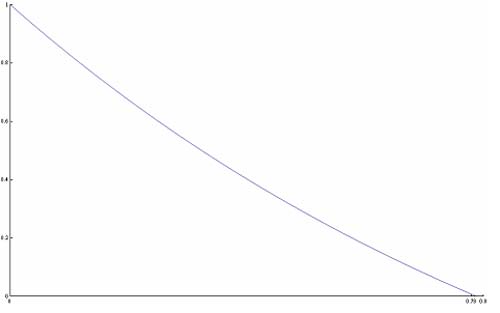
Another method, though
less precise, would have
been a graphical one.
In this graph I have
plotted f(x) and the
solution is given by the
intersection with
the x-axis.
Simon used the Newton-Raphson method and a computer to work out the
answers to this part. Differentiating the function
gives
Using the Newton-Raphson formula:
gives
As the notes allow us to use a programmable calculator, which I
interpreted to mean computer, as that is essentially what a computer
is, I coded a script in C to do this problem for me. The approximate value for x: 0.784453067133075 (using
.)