Quaternions are 4-dimensional numbers of the form $(a,x,y,z)=
a+x{\bf i}+y{\bf j}+z{\bf k}$ where $a, x, y$ and $z$ are real
numbers, ${\bf i, j}$ and ${\bf k}$ are all different square
roots of $-1$ and ${\bf i j} = {\bf k} = {\bf -j i},\ {\bf j k} =
{\bf i} = {\bf -k j},\ {\bf k i} = {\bf j} = {\bf -i k}.$
The quaternion $a + x{\bf i} + y{\bf j} + z{\bf k}$ has a real
part $a$ and a pure
quaternion part $x{\bf i} + y{\bf j}+ z{\bf k}$ where
${\bf i, j}$, and ${\bf k}$ are unit vectors along the axes in
${\bf R^3}$.
(1) For the pure quaternions $v_1 = x_1{\bf i}+y_1{\bf j} +
z_1{\bf k}$ and $v_2 = x_2{\bf i} +y_2{\bf j} +z_2{\bf k}$
evaluate the quaternion product $v_1v_2$ and compare your answer
to the scalar and vector products $v_1 \cdot v_2$ and $v_1 \times
v_2$.
(2) Evaluate the quaternion product $v^2$ where $v=x{\bf i} +
y{\bf j} + z{\bf k}$ and $|v| = \sqrt (x^2 + y^2 + z^2) = 1$.\par
Show that, for all real angles $\theta$ and $\phi$, $$v = \cos
\theta \cos \phi {\bf i} + \cos \theta \sin \phi {\bf j} + \sin
\theta {\bf k}$$ is a square root of -1. This gives the set of
all the points on the unit sphere in ${\bf R^3}$ and shows that
the quaternion $-1$ has infinitely many square roots (which we
call unit pure
quaternions ).
|
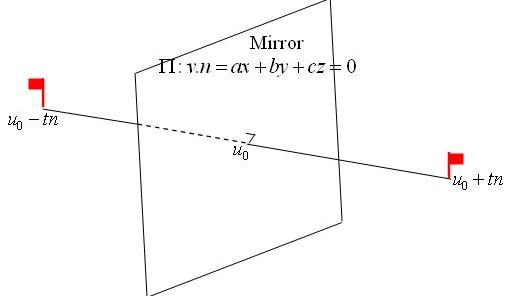
(3) Take any unit pure quaternion $n$ ($n^2=-1$) and
consider the plane $\Pi$ through the origin in ${\bf
R^3}$ with normal vector $n$. Then the plane $\Pi$ has
equation $a x + b y + c z = 0 = v\cdot n$.
If $u_0$ is a point on the plane $\Pi$ then $u_0\cdot n
=0$ and the points $u_0+ t n$ and $u_0 - t n$ are
reflections of each other in the plane.
|