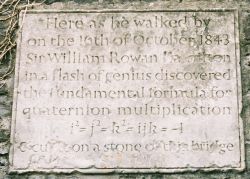
Plaque on Broom Bridge

To do this problem you only need to know how to add and multiply two by two matrices. The problem gives models for complex numbers and 4-dimensional numbers called quaternions. Although you don't need the information to do this problem you may like to read the NRICH article What are Complex Numbers? and the Plus article:Curious Quaternions .


(1) Let C* be the set of 2×2 matrices of the form
( x-y yx )

where x and y are real numbers and addition and multiplication are defined according to the usual rules for adding and multiplying matrices.

(a) Add and multiply the matrices
( x -y y x )and( u -v v u ).

(b) What are the identities and inverses for addition and multiplication?

(c) Consider also the subset R* for which y=0. Investigate the arithmetic of R* (addition, subtraction, multiplication, division, identities, inverses, distributive law) and compare it with the arithmetic of real numbers.

(d) Compare the arithemetic of C* with that of complex numbers.

(e) The matrix ( -1 0 0 -1 ) is equivalent to the real number -1. What is the matrix equivalent to i=-1 in the set of complex numbers?


(2) Complex numbers are two-dimensional numbers x+iy where x and y are real numbers and i=-1. Quaternions are four-dimensional numbers of the form a+ix+jy+kz where a,x,y,z are real numbers and i,j,k are all different square roots of -1.

Can such a number system exist? To answer this, let's assume that in part (1) you have established that if real numbers and 2 by 2 matrices exist then so does the complex number i=-1. The model for the system of quaternions is the set of linear combinations of 2 by 2 matrices:
aI+ix+jy+kz=a( 1 0 0 1 )+x( i 0 0 -i )+y( 0 1 -1 0 )+z( 0 i i 0 ).

where a,x,y,z are real numbers.

(a) Work out the matrix products: i2 , j2 and k2 showing that these matrices give models of three different square roots of -1.

(b) Work out the matrix products: ij, ji, jk, kj, ki and ik showing that the three matrices i,j,k model unit vectors along the three axes in 3-dimensional space R3 with matrix products isomorphic to vector products in R3 .

You have now shown that this set of linear combinations of matrices models the quaternions.

(3) Investigate the sequence: i, ij, ij k, ij ki, ij ki j,...

... and the story continues in the Plus article: Ubiquitous Octonions.