Aleksander from Gdynia Bilingual High
School No 3, Poland used the properties of the sine function to
find a polynomial approximation.
As we know, polynomials are one of the most flexible functions and
hence, can have very different shapes. They are probably the most
flexible functions you can find, thus we can state a hypothesis that
every function can be approximated by a polynomial of an appropriately
high degree. Let's now consider sine, the functions that is very
difficult to calculate and thus we usually need its approximation.
In the beginning let's find coefficients in the following expression:
Let's make a few observations:
(1) Sine is an odd function
(2)
(3) For sufficiently small
,
. Polynomials are odd only if coefficients of even powers of
are equal to 0.
From the statements above we have:
From (3),
From (1),
.
After simplification
. Taking
and
a simple calculation gives
which is
close to
and we have
. To get approximation of
using polynomials of higher degrees, we have
to remember that coefficients of even powers should be equal to 0. For that
reason the next degree of a polynomial that can be used here is the 5th.
Andrei from Romania used the Taylor
series and drew graphs to show the polynomial approximations
.
To solve this problem, I use the Taylor series expansion around the
origin. I see that the derivatives of
are:
|
|
The formula for the Taylor expansion is:
|
|
Evidently, the odd-order derivatives are 0 for
. So,
could be written around the origin as:
|
|
The simplest method to test the accuracy of the series expansion is
to represent on the same graph the function and its different order
expansions.
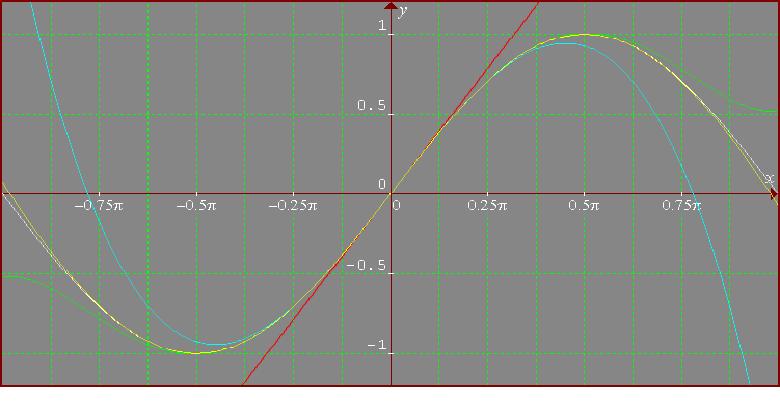
The function sin(x) is represented in white, the first order
polynomial in red, the third in cyan, the fifth in green and the
seventh in yellow. It can be observed that the accuracy is better
and better. As the order of the polynomial increases, the accuracy
increases.
It is remarkable that, using only up to the seventh order
polynomial, I obtain a very good approximation of the function. Sin
is a periodic function and so it is sufficient to work on the
interval
, and, observing that sin is an odd function
the interval
is enough. Around
, in fact I should
use the expansion of the function around this value. This is
equivalent to moving the y-axis
to the right.
I work in a similar manner for
and
For
, the MacLaurin series expansion is:
|
|
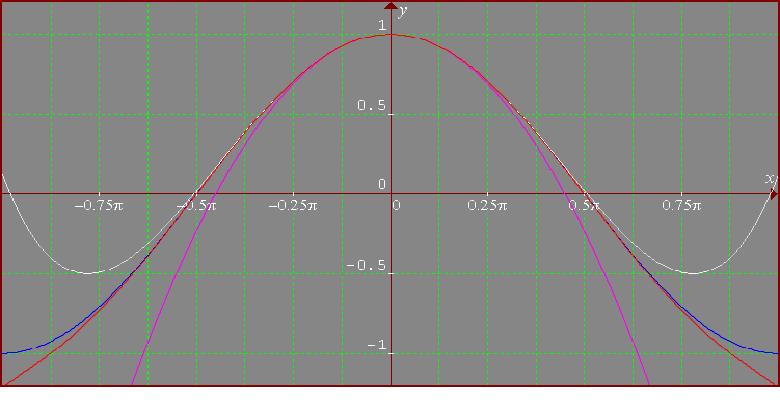
The function is in blue, the second order polynomial in violet, the
fourth - in white and the sixth in red. I see that the sixth order
polynomial is a rather good approximation on the whole interval.
As cos is periodic, the interval
is sufficient, and
more, as cos(x) is even
is enough.
For,
, I consider the logarithm to the base e. Here, I obtain the
following MacLaurin series expansion:
|
|
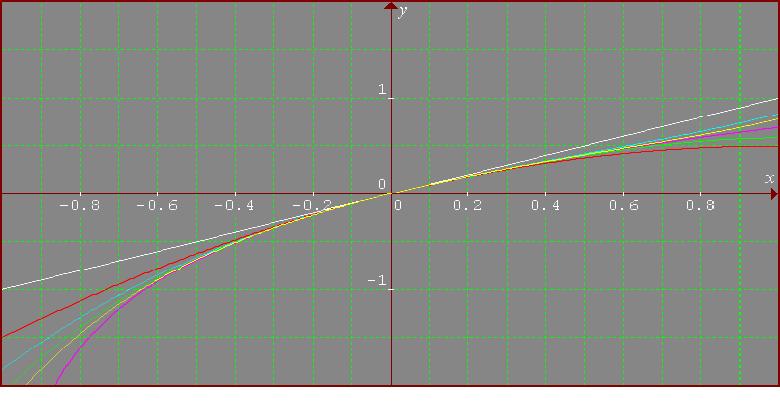
Here, the colours of the curves are as follows: violet for the
function, white for the first order approximation, red for the
second, cyan for the third, green for the fourth and yellow for the
fifth.
In this case, the approximations are good only on a small interval
around the origin. I think that for approximations of the function
valid on different intervals, I have to use the series expansion
around the chosen point. So, around x=1:
|
|
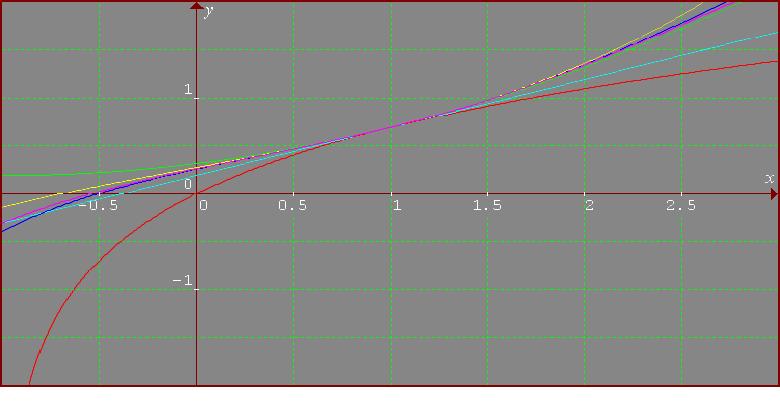
The colours are as follows: the function in red, the first order
polynomial in cyan, the second order one in green, the third in
yellow, the fourth in blue, and the fifth in violet.