triangle
Many thanks Andrei from Tudor Vianu National College, Bucharest, Romania for another excellent solution.

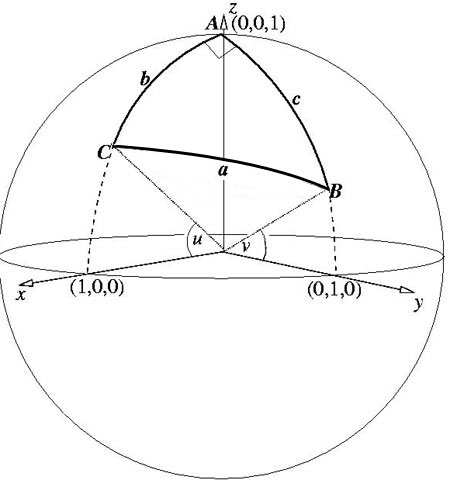
To solve the problem I have used the hint, so that all notations are from the hint. I have associated to the sphere a system of Cartesian coordinates, as shown in the sketch.

Without loss of generality, I have assumed that $A$ is situated on $Oz$, and has coordinates (0, 0, 1). As $A$ is a right angle, I can assume that $B$ is situated in the plane $yOz$ and $C$ in plane $xOz$ respectively.

Let the angle $xOC$ be $u$, and angle $yOB$ be $v$. So, the Cartesian coordinates of the three points, which correspond to the vectors OA, OB and OC , are: $$A(0, 0, 1),\ B(0, \cos v, \sin v),\ C(\cos u, 0, \sin u).$$
Arcs AB,BC and CA are arcs on the three great circles (of radius unity), so that their lengths are equal to the angles at the centre in the corresponding great circle (expressed in radians). So, as shown in the figure:
BOC=a,AOC=b= π 2 -u,AOB=c= π 2 -v.   (1)

To calculate the length of arc BC I use the same procedure as in the problem "Flight path". I calculate first the straight line distance between B and C inside the Earth:
BC2 = cos2 u+ cos2 v+ sin2 u+ sin2 v-2sinusinv=2(1-sinusinv).   (2)

But from (1) I observe that sinu=cosb and sinv=cosc. Using these and (2), I obtain BC2 :
BC2 =2(1-cosbcosc).   (3)

Applying the cosine theorem in triangle BOC, I shall obtain the measure of BOC, which is given by:
BC2 = BO2 + CO2 -2BO×COcosa=2(1-cosa).   (4)

From (3) and (4) we get Pythagoras Theorem on the sphere:
cosa=cosbcosc.

An alternative proof of Pythagoras Theorem on the sphere uses scalar products as follows.

Since OA,OB and OC are unit vectors, the angles between the vectors, and hence the lengths of the sides of triangle ABC, are given from the scalar products:
a = cos-1 OB.OC= cos-1 sinusinv b = cos-1 OA.OC= cos-1 sinv c = cos-1 OB.OA= cos-1 sinu.

Hence
cosa=cosbcosc.

For the second part of the problem I observe that the triangle with vertex coordinates (0, 0, 1), (0, 1, 0) and (1, 0, 0) has 3 right angles. The lengths of its sides are all π/2. Now I shall prove that all spherical triangles with 3 right angles are equilateral of side π/2. All the following relations follow from the version of Pythagoras Theorem proved above as angles A=B=C=π/2.
cosa =cosbcosc.   (5) cosb =cosccosa.   (6) cosc =cosacosb.   (7)

Multiplying (5), (6) and (7), I obtain:
cosacosbcosc=(cosacosbcosc )2 .

If cosa,cosb,cosc0, then cosacosbcosc=1. But -1cosa,cosb,cosc1. So, cosa=cosb=cosc=1, which means a=b=c=0 (impossible) or cosa=cosb=-1 and cosc=1 (or any other combination of a,b and c), which is also impossible.

So, one of cosa,cosb or cosc is 0. Now, evidently cosa=cosb=cosc=0, so a=b=c=π/2, and all triangles with this property are congruent.