|
If you wear a different coloured T-shirt every day someone may say that you are "ringing the changes". This expression simply means that you plan for variety rather than keeping things the same. It comes from the the custom of ringing church bells. |
In East Anglia, as you look across the fens, villages appear almost like little islands (indeed some of them were islands before the fens were drained) and these villages are dominated by big churches with tall towers. In the past people regulated their lives and passed messages by ringing church bells, which could be heard for miles around, telling the time of day, and giving news of births, marriages and deaths in a parish. The following quotation comes from the ringer's rules from Southhill in Bedfordshire "When mirth and pleasure is on the wing we ring; at the departure of a soul we toll".
Bell ringing is good exercise for the body and mind, the bells are heavy and the bellringers have to remember the changes. Bell ringing often appeals to mathematicians because there is a lot of mathematics to be found in these complicated sequences of changes. Before reading on you might like to try this problem on bellringing.
The mathematics of the changes
|
The reader is invited to investigate permutations in
the ringing of church bells, that is the different
orders in which the bells can be rung on a ring of
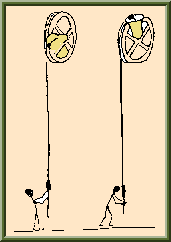
bells. Each bell is mounted on a wheel and controlled
by a bellringer pulling on a rope. A bell rings once
per revolution. Roughly speaking it rotates 360 degrees
from top-dead-centre back to top-dead-centre and
strikes (once) when it is about 70% of the way round.
The bell rings alternately clockwise and anti-clockwise
(roughly 360 degrees each way) and two revolutions
constitute a so-called whole pull. Rather confusingly a
whole pull (singular) consists of two pulls (plural) on
the rope.
The bellringer can speed up or slow down his or her
bell to alter its turn in the order by one place, but
not by more than one. Each bell is rung just once in a
sequence (a row), then all the bells are rung again,
but in a different order (a permutation of the previous
order), then all again in a different order and so on.
We say the bells are rung in rounds when the bells are
rung in order with the notes descending in pitch from
the lightest bell, the treble, to the heaviest, the
tenor.
|
 |
 |
So for example, with just three bells there are six
possible orders in which they can ring. Mathematically
speaking there is a group of six bell ringing rows.
Starting with the row 123 the next could be 213
(interchanging the order of the first two ) or 132
(interchanging the order of the second two), but it
could not be anything else.
When the order in which the first two bells are rung is
interchanged we call the change p, and when the order
of the second pair are interchanged we call the change
q.
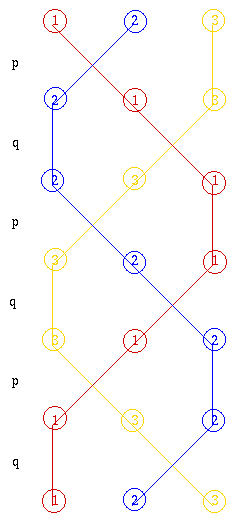
One way of ringing every posible row once beginning and
ending with rounds is to ring the changes p then q then
p then q then p and finally q again as illustrated by
this braid diagram. Each line shows the order in which
the bells are rung and the bellringers remember their
'parts' by remembering the shape and pattern of their
strand in the braid.
|
| A circuit diagram provides another way of illustrating these changes. Here we see the change p illustrated by a black line, and q by a blue line. Each node represents one of the six permutations. By traversing the circuit either clockwise or anticlockwise, we see two ways to ring a block denoted by and . | 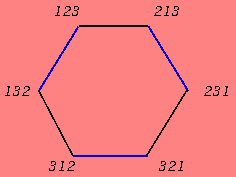 |
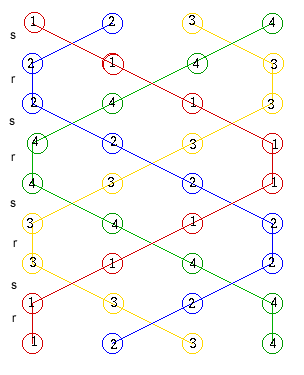
Braid diagram 2
Plain Hunt Minumus.
|
The first pair can be transposed and the second pair
stay the same, we call this p, the second pair can be
transposed and the first pair stay the same, we call this
q, the middle pair can be transposed and we call this r,
and finally both pairs can be transposed and we call this
s. The bellringers' notation records the bells that don't
move so what we record as p or X|| is written 34, what we
record as q or ||X is written as 12, what we record as r or
|X| is written as 14 and what we record as s or XX has the
special name 'cross'. Repeating and alternately gives the sequence of changes shown in braid diagram 2 which is denoted by representing Plain Hunt Minimus. Braid diagram 2 does not give all 24 permutations although it does start and finish with the same row and bellringers describe this as a round block. Braid diagram 3 gives an example where all 24 rows occur once and only once and the sequence starts and ends with the same row. |
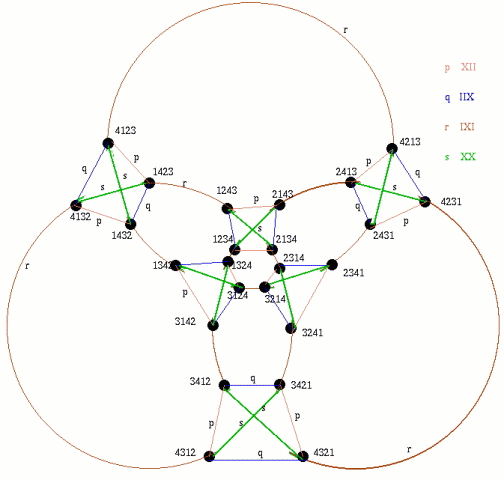
Bellringers are interested in different ways of ringing all possible changes without repeats which is known as an extent and braid diagram 3 shows an example of an extent on four bells. If you start at 1234 in the network diagram above can you trace a path around the network corresponding to braid diagram 3 visiting each vertex in the network once and only once? Start at the vertex representing 1234 then follow the green path for the permutation s to the vertex for 2143, then follow the red path for the permutation r to the vertex for 2413 and so on... and finally return to the starting point along the yellow path for the permutation p from the vertex 2134 to the vertex 1234. This is denoted by . Can you find other Hamiltonian circuits around the network visiting every vertex once and only once, and can you draw their corresponding braid diagrams? For example, to ring what bellringers call Plain Bob, you follow the path and then instead of switching by from 1324 to 3124 you switch by from 1324 to 1342 and use again rather than later in the sequence giving . Each bellringer remembers his or her pattern in the braid and, in particular, the 'dodges', for example where bell number 1 permutes with 3 and then with 3 again at the first occurrence of the permutation in braid diagram 3. |
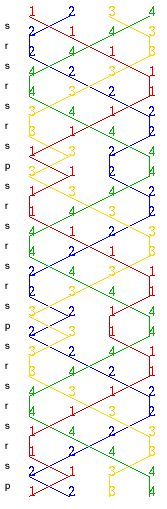
Braid diagram 3 represents
an extent on four bells.
|
 |
In addition to studying the mathematics of bellringing,
there is an interest in investigations into the
mechanics of church bell ringing as described in this
news item from the Cambridge University website of 17th
January 2005:
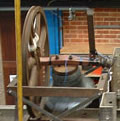
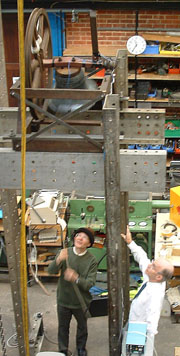
"As part of a fourth-year student project on the
mechanics of church bell ringing, a "bell tower" has
been built in the Mechanics Laboratory. The bell has
been instrumented to provide data on the movements of
bell and clapper, to compare with a theoretical model.
In this picture, the bell is being rung by Dr Frank
King of the Computer Laboratory, who is the official
University Bellringer. He is being watched by Professor
David Newland, past head of the Engineering Department
and a keen bellringer. "
|
The next article will explain the group theory which underlies these ideas and which is represented by the network diagram.
Further information can be found in Frank King's book Ringing Elementary Minor Methods on Handbells and on the Central Council of Church Bellringers website and the Wikepedia website and many more.