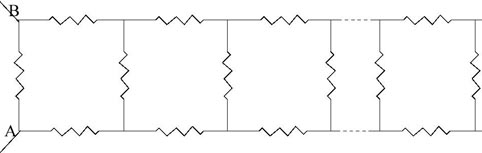
Aleksander from Gdynia Bilingual High School No 3, Poland, David
from Guilford County (is that UK, US or elsewhere?) Andrei from
Romania and Chris from CSN used different methods to solve this
problem, all of them leading to solving a quadratic equation. Chris
used the observation that, removing three resistors leaves the
resistance of the remaining network unchanged, and quickly arrived
at the quadratic equation which gives the solution. Aleksander
visualised the network in a different, but equivalent, configuration
and used continued fractions and David's method was similar. Andrei
arrived at the same quadratic equation by first proving that the
sequence of resistances R0, R1, R2, ... from A to B,
corresponding to different number of resistance 'squares', is a
steadily decreasing sequence and, as Rn > 0, the sequence tends
to a limit. This is Chris's solution:
Following the hint, keep in mind that the equations for series
resistances and parallel resistances are: R = R1 + R2 for series
and R = (R1 ×R2)/(R1 + R2) for parallel.
The resistance R between A and B is the equivalent of a resistance of
1 ohm in parallel with two resistances of 1 ohm and a resistance R
in series and we can write the following equation:
R =
1 ×(2 + R)1 + (2 + R)
=
(2 + R)(3 + R)
.
Reworking the above equation we get: R(3 + R) = (2 + R) or
R2 + 2R - 2 = 0.
Solving the quadratic equation we get two solutions, one of which we
cannot use because it is negative, so R = - 2.73205 is not valid
because a resistance cannot have a negative value. The correct
solution is:
R = Ö3 -1 » 0.732051.
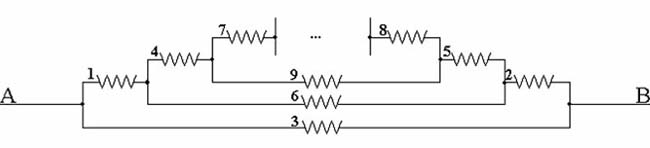
This is Aleksander's solution: Generally it is easier to calculate the resistance of a circuit when you
present it in a way that one end of circuit (here A) is on the left
and the other is on the right. Here we have an illustration of our
ladder circuit in such a way making it much easier to justify whether two
resistors are in parallel or in series.:
From the picture we know that resistors
labeled 1, 2 and the group of resistors 4,5,6,7,8,9 (all 1 ohm) are
connected in series. We can also observe that the resistor 3 is
connected in parallel to the resistors mentioned before. Therefore,
where R is the resistance of the whole circuit, and Rn is the
resistance of the nth resistor, we can write:
R =
1
1R3
+
1R1 + R2 +...
.
The three dots refer to the resistances of the resistors not
mentioned in the formula, but occurring in the further part of the
circuit.
We can observe that the pattern for the first three resistors
repeats for the rest so
R =
1
1R3
+
1
R1 +R2 +
1
1R6
+
1R4 +R5+...
and the fraction
grows like that to infinity. As all the resistances are 1 ohm this
gives the continued fraction:
R =
1
1 +
1
2 +
1
1 +
12 +...
=
1
1 +
12 + R
After a few simplifications we obtain the quadratic equation :
R2 + 2R - 2 = 0. As R must be positive the solution is
R = Ö3 - 1 ohms.
This is Andrei's solution:
First I shall prove that the resistance
from A to B tends to a limit as more 'squares' are added to the network.
I shall denote the value of each resistance by R and the values of the
equivalent resistances between A and
B, corresponding to different number of resistance 'squares', by
R0, R1, R2, ... etc. Evidently R0 = R and R1 = 3R/4.
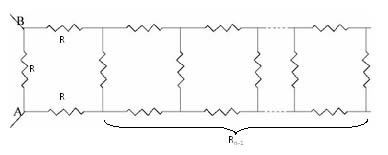
From the diagram I observe that:
1Rn
=
1R
+
12R +Rn-1
.
where R = 1. I observe that R1 < R0, and I shall prove by induction that
Rn < Rn-1. This, by the recurrence relation, is equivalent to:
Rn < Rn-1Û
1Rn
>
1Rn-1
Û
1R
+
12R + Rn-1
>
1R
+
12R + Rn-2
Û Rn-1 < Rn-2.
So, the sequence (Rn) is strictly decreasing. Evidently Rn > 0
so the sequence (Rn) is convergent. By considering the limit in
the recurrence relation (putting R=1),
lim n® ¥
Rn =
1
1+
1
2 +
lim n® ¥
Rn-1
where
lim n® ¥
Rn =
lim n® ¥
Rn-1 = RL.
This
gives
RL =
2+ RL3 + RL
and hence the quadratic equation
RL2 + 2RL - 2 = 0. The positive solution of this equation gives
the resistance of the network: Ö3 - 1 ohms.