|
| R = |
2 + R 3 + R |
giving the quadratic equation R2 +2R -2=0. Solving this equation, as R ³ 0 the solution is R=Ö3 -1 .
|
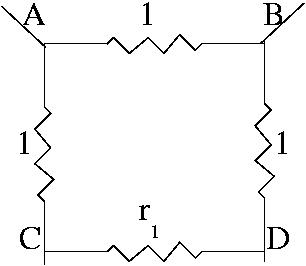
Denote the resistance of the infinite
network by R. By removing just three
resistances from the infinite circuit
the resistance of the remaining
infinite circuit is unchanged. The
resistance between A and B is the same
as the resistance between C and D
cutting out the three resistances above.
Hence r1 = R which gives
giving the quadratic equation R2 +2R -2=0. Solving this equation, as R ³ 0 the solution is R=Ö3 -1 . |
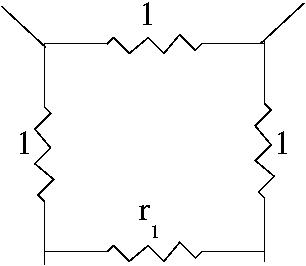 |
In this diagram r1 replaces the
total resistance of the remaining
network.
Taking R1 as the total of these 4
resistances:
|
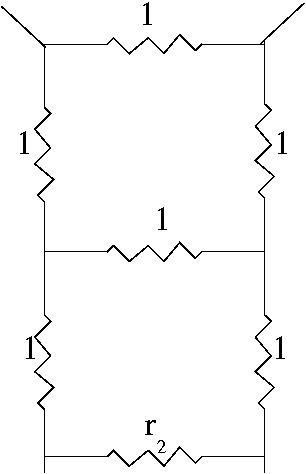
Now replacing r1 by 4
resistors where r2 replaces
the total resistance of the
remaining network as shown in
the diagram we have
|
 |
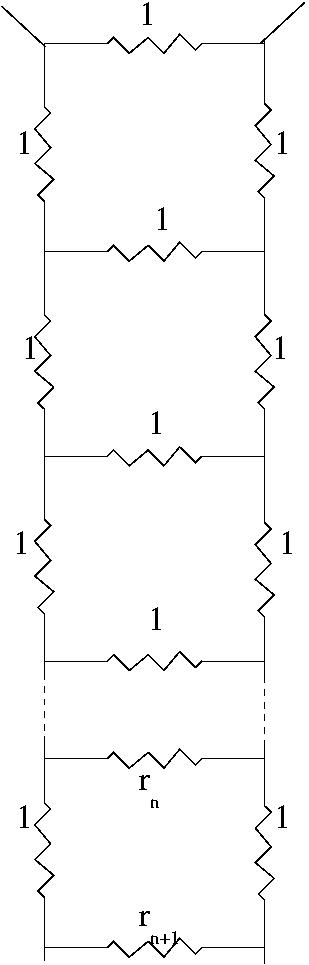 |
Each time we add another 3
resistances to the network
we replace rn by a
resistance of 1 ohm in parallel
with 3 more resistances
of 1, rn+1 and 1 ohm
in series such that
and hence R2 +2R-2 = 0 so R = -1 ±Ö3. As R must be positive we have the solution R=Ö3 -1 . |