Thank you Andrei from Tudor Vianu National College, Romania for your solution.

(1) First, I make the substitution t=x-1/2 in the equation:
2 t3 +3 t2 -11t-6=0.

I obtain:
2(x- 1 2 )3 +3(x- 1 2 )2 -11(x- 1 2 )-6=0.

This equation is transformed into x3 - 25x 4 =0. This equation could be written
x(x- 5 2 )(x+ 5 2 )=0

with 3 solutions x=0,+ 5 2 ,- 5 2 which correspond to t= 1 2 ,3,-2 respectively.

(2) Now I shall analyse what happens to the graph of y= x3 +px+q and to the solutions to the equation x3 +px+q=0 if I keep p constant and I change q. The graph is translated parallel to the y-axis. There will always be at least one intersection with the x-axis, giving one real root of the equation, and for some values of q this will be the only intersection, for the other values of q there will be 3 intersections, corresponding to 3 real roots and, for one value of q, two of the three with roots are coincident.

(3) If q is fixed, the intersection of the graph with the y-axis is fixed and this time, changing p changes the shape of the graph. Again there is always one real root and, for some values of p there are 3 real roots while for other values of p there is only one real root.

(4) For p=0,q=8 the applet gives the following solutions to x3 +8=0values:
(-2,0)(1,1.73),(1,-1.73).

Now, I shall solve the equation x3 +8=0. I factor the expression as follows:
(x+2)( x2 -2x+4)=0.

One solution is evidently x1 =-2. The other 2 could be found solving the second order equation:
x2 =1+i3


x3 =1-i3.

Now I shall prove that the 3 roots are equally spaced in the Argand diagram, being situated on the circle of centre (0,0) and radius 2. For this, I calculate the moduli of the 3 complex numbers:
| x1 |=2


| x2 |=(1+3)=2


| x3 |=(1+3)=2.

Hence the numbers in modulus argument form (r,θ) are (2,0),(2, 120o ),(2, 240o ).

(5) Some results are summarized in the following table:
p=-3 (constant) Red frame (p, q) Blue frame y= x3 +px+q Green frame '?? Argand diagram (p, q)
q<-2 (p, q) is on the right of the curve. The graph intersects the x-axis in only one point, with the x-coordinate positive. One point is son the x-axis (x> 0) (corresponding to the real root); the other 2 are symmetric with respect to the x-axis (they are complex conjugates)
q=-2 (p, q) is on the curve. The graph intersects the x-axis in one point and it is an inferior tangent to the x-axis Only real roots, two of which are equal: x1 =2, x2 =x3=-1
-2<q<2 (p, q) is on the left of the curve The graph intersects the x-axis in 3 points, not all having the same sign. All points are on the x-axis.
q = 2 (p, q) is on the curve The graph intersects the x-axis in one point and it is a tangent to the x-axis Only real roots, two of which are equal: x1 = x2 =1, x3 =-2
q>2 (p, q) is on the right of the curve The graph intersects the x-axis in only one point, with the x-coordinate negative One point is situated on the x-axis (x< 0) (corresponding to the real root); the other 2 are symmetric with respect to the x-axis (they are complex conjugates)


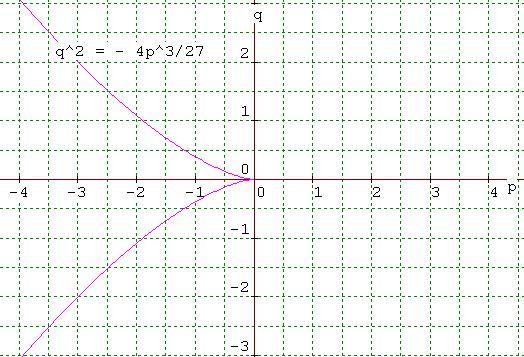
By experimenting with the applet one finds that the curve in the red frame seems to be the boundary such that points (p,q) to the left of this curve correspond to graphs y= x3 +px+q with equations x3 +px+q=0 having 3 real roots, points on the curve to equations with 3 real roots where 2 are coincident, and points to the right of the curve to equations with only one real root.

The curve has equation q2 =- 4 p3 27 so the points (-3,-2) and (-3,2) are on the curve.

cubic regions graph


Discriminant The equation Q(x)= x3 +px+q=0 has derivative Q'(x)=3 x2 +p and turning points where x=±- p 3 . Write p=- s2 then the turning points are x=± s 3 . The condition for three real roots is that one turning point has a positive y coordinate and the other a negative y coordinate, i.e.
[ s3 33 - s3 3 +q][- s3 33 + s3 3 +q]0

which reduces to
[q- 2 s3 33 ][q+ 2 s3 33 ]0

i.e.
q2 4 s6 27 ,    q2 4 p3 27 .

(2)in more detail.Considering the general cubic, the equation
at3 + bt2 +ct+d=0

becomes
t3 + b a t2 + c a t+ d a =0.

Making the substitution t=x- b 3a gives the equation:
(x- b 3a )3 + b a (x- b 3a )2 + c a (x- b 3a )+ d a =0.

Expanding and simplifying this equation reduces to:
x3 -3( b 3a ) x2 +3( b 3a )2 x-( b 3a )3 + b a ( x2 -2( b 3a )x+( b 3a )2 )+ c a (x- b 3a )+ d a =0.

Clearly the coefficient of x2 is zero and the equation reduces to x3 +px+q=0 where p and q depend on a,b,c and d.