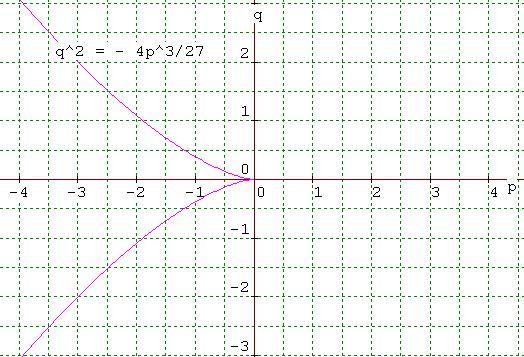
|
p = - 3 (constant)
|
Red frame (p, q) |
Blue frame y = x3 + px + q
|
Green frame '?? Argand diagram (p, q) |
|
q < - 2
|
(p, q) is on the right of the curve. |
The graph intersects the x-axis in only one point, with
the x-coordinate positive. |
One point is son the x-axis (x> 0)
(corresponding to the real root); the
other 2 are symmetric with respect to the
x-axis (they are complex conjugates)
|
|
q = -2
|
(p, q) is on the curve. |
The graph intersects the x-axis in one point and it is
an inferior tangent to the x-axis |
Only real roots, two of which are equal:
x1 = 2 , x2 = x3 = -1
|
|
-2 < q < 2
|
(p, q) is on the left of the curve |
The graph intersects the x-axis in 3 points, not all
having the same sign. |
All points are on the x-axis. |
| q = 2 |
(p, q) is on the curve |
The graph intersects the x-axis in one point and it is
a tangent to the x-axis |
Only real roots, two of which are equal:
x1 = x2 = 1, x3 = -2
|
|
q > 2
|
(p, q) is on the right of the curve |
The graph intersects the x-axis in only one point, with
the x-coordinate negative |
One point is situated on the x-axis
(x< 0) (corresponding to the real root);
the other 2 are symmetric with respect
to the x-axis (they are complex
conjugates)
|