1)Making the substitution t=x- 1 2 , the cubic equation
2 t3 +3 t2 -11t-6=0

becomes
t3 + 3 2 t2 - 11 2 t-3=(x- 1 2 )3 + 3 2 (x- 1 2 )2 - 11 2 (x- 1 2 )-3=0.

Simplifying this equation we get:
x3 - 3 2 x2 + 3 4 x- 1 8 + 3 2 ( x2 -x+ 1 4 )- 11 2 (x- 1 2 )-3=0

and collecting like terms we get
x3 - 25 4 x=0

which has solutions x=0 and ± 5 2 . The equivalent values of t are 0- 1 2 =- 1 2 and ± 5 2 - 1 2 =2 and -3.

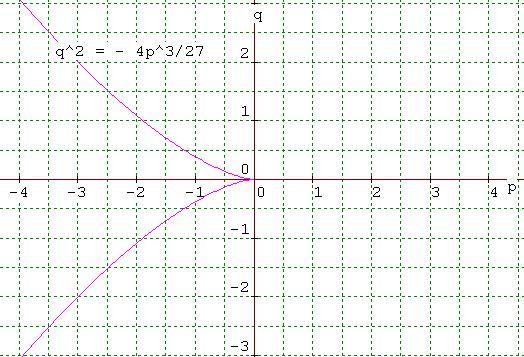
(4) The equation Q(x)= x3 +px+q=0 has derivative Q'(x)=3 x2 +p and turning points where x=±- p 3 . Write p=- s2 then the turning points are x=± s 3 . The condition for three real roots is that one turning point has a positive y coordinate and the other a negative y coordinate, i.e.
[ s3 33 - s3 3 +q][- s3 33 + s3 3 +q]0

which reduces to
[q- 2 s3 33 ][q+ 2 s3 33 ]0

i.e.
q2 4 s6 27 ,    q2 -4 p3 27 .

cubic equation regions