You don't have to know any music theory
to do this question as all you need to know is explained here.
You only need to know about logarithms. The actual problems to
solve are given in bold italic text.
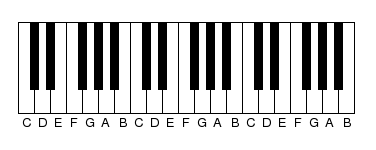
Diagram showing part of a piano keyboard.
Wherever you are on the keyboard, the interval between one note and the
next with the same letter name is always an octave. In the same way, the
interval between C and the G above it, or D and the A above it, or anything
similar (seven steps on the keyboard, including both black and white notes),
is always a fifth. Each of these intervals, the octave, the fifth, and
others, corresponds to a particular ratio of string lengths which produce
the notes. The octave corresponds to 2/1, halving the length of the string.
The fifth corresponds to 3/2, taking two thirds of the length of the string.
The interval from C to F, called a fourth, has the ratio 4/3.'Fourth' and
'fifth' etc. are musical terms and do not refer to the fractions 1/4 and 1/5.
The interval from F to G, between the fourth and the fifth, has the ratio
. This interval is called a tone and it is also the
the interval from C to D.
Notes tuned in these ratios produce pleasant harmonies but compromises have to
be made in tuning the other notes because the ratios do not
relate to each other exactly. This problem is about discovering what the
compromises might be. The table below shows some musical intervals and the
corresponding ratios of the notes with respect to the note C.
| C |
D |
E |
F |
G |
A |
B |
C |
|
1/1
unison
|
9/8
tone
|
81/64 |
4/3
fourth
|
3/2
fifth
|
27/16 |
243/128 |
2/1
octave
|
The Pythagorean Scale
You might expect there to be three tones in the
interval from C to F, changing the ratio by 9/8 then 9/8 again and then 9/8
a third time, that is (9/8)3. How does this compare with the
ratio 4/3?
Pythagorean tuning kept the ideal ratios for the octaves, fifths and
fourths and tuned the note E with a ratio (9/8)2 and the notes A and
B with the ratios (3/2)×(9/8) and (3/2)×(9/8)2.
This system preserves the ratios of the fourth and fifth but
produces a major third, from C to E and a major sixth, from C to A,
which sound unpleasant. The Greeks were not interested in these
intervals, but when composers in the middle ages and Renaissance
wanted to use them, a new system of tuning was needed.
Just intonation (shown in the table below) has much better major
thirds and major sixths, of 5/4 and 5/3. It tunes the B so that the
interval from E to B is a perfect fifth and the interval from G to B
is a perfect third. But it does this by having two different sizes of
tone: the intervals C-D and D-E are different here, but they were
the same in the Pythagorean scale. Find the ratio corresponding to B.
Also compare the D-A ratio with the ideal fifth (3/2).
| C |
D |
E |
F |
G |
A |
B |
C |
|
1/1
unison
|
9/8
tone
|
5/4
third
|
4/3
fourth
|
3/2
fifth
|
5/3
sixth
|
? |
2/1
octave
|
Just Intonation
You might expect there to be six tones and twelve semitones in an octave
(because there are 12 notes) but again that is not exactly so.
Find exactly how many tones there are in an octave by finding what power
of
gives 2. Find also exactly how many major thirds there are in
an octave.
In the equal tempered scale, the standard tuning nowadays, these
mismatches between
different ratios are removed by defining the intervals differently.
The tone is made a little smaller, so that there are exactly six of
them in an octave. The semitone (half a tone) is a twelfth of an
octave: so its ratio is (2)1/12. If, for example, the note C is
tuned with a string length of 32 units then the C# is tuned with a string
of length
(to 3 significant figures).
This applet
by Benjamin Wardhaugh demonstrates the relationship between the string
lengths and the notes. The ratio (2)1/12 is used to build up the
other intervals, so that each interval is a whole number of semitones, and
the ratio between its frequency and the frequency of the lowest note
in the scale is given by a power of (2)1/12. For example the
fifth is (2)7/12.
Instrument tuners customarily use a logarithmic unit of measure, the cent,
where 1200 cents are equal to one octave, a frequency ratio of 2/1,
so that a cent is a 1200th root of 2. The table below shows the
Equal tempered, Pythagorean and Just systems of tuning given in cents showing
how many cents the note lies above the starting C.
Fill in the table.
|
C |
D |
E |
F |
G |
A |
B |
C |
| Equal tempered scale |
0 |
200 |
400 |
500 |
700 |
900 |
1100 |
1200 |
| Pythagorean scale |
0 |
|
|
|
702 |
|
|
1200 |
| Just intonation |
0 |
|
386 |
|
702
|
|
|
1200 |