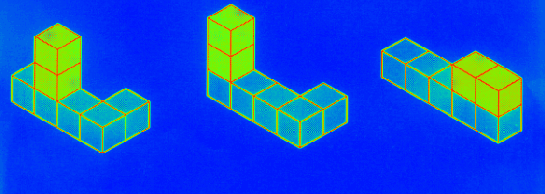
Let's get straight in and look at the different kinds of
recordings that I've met in Primary schools when working with
pupils in Mathematics lessons - particularly those lessons that
have been focussed on concept development, problem solving and
using and applying mathematics.
1. Pen and paper recording
Sometimes pupils record
because there is not sufficient equipment for them to make new
examples. So each time the example has to be broken up in order
that a new one can be created, such as in the problem
Two on Five , published in November 1997.
The recording I've witnessed in this activity has been very
varied:
- The younger child has drawn - rather freely - around the
base of the shape they have just made and their drawing doesn't
look much like the shape. The purpose then might be just to
help the pupil to check that they have not repeated any of
their own ideas.
- At another stage the pupil draws around the shape rather
more accurately and makes some extra mark to show the position
of the cubes that are on top.
- Then we get to those who do not draw around the shape and
simply look at the object they have made and transfer their
idea onto paper - probably squared - using either a bird's eye
view or a side view.
- Some pupils have invented ways of showing when the two
upper cubes are actually placed on top of each other.
- There are those who make use of colours and show the ones
on top by a new 'code'.
- Others like to use arrows accompanied by a few words to
show more clearly where the cubes are placed.
- Some -usually older pupils- make use of symbols and have no
drawing as such.
All the examples above have emerged when the teacher has added
to the explanation of the challenge that the recording they do
is purely for THEIR benefit, and does not necessarily have to
make sense to an observing adult.
2 Photographic record
Sometimes it has been appropriate to take a digital photo of
the accomplishment because the achievement has been to produce
and not to just record. An example of such an activity might be
to find out how many different shapes can be produced with 3
multilink cubes, then 4, 5 etc.
3 Practical making
Sometimes it is possible to make solutions to an investigation
when there has been a lot of thought, trying alternatives and
discussion going on.
Tea Cups , published in December 1997, lends itself to this
way of recording.

I have felt for a long time now that there are quite a few
good reasons for pupils to record their work when involved in
using and applying mathematics, and these are not just about
satisfying adults that the work has been carried out!
- If pupils leave their work -to go to toilet, lunch, sharpen
a pencil etc they'll know where they've got to on return.
- To be able to see if - when applicable - they're doing
unnecessary repeats.
- To give them opportunities to see any patterns
evolving.
- To get some extra idea of further work they could do - ones
in a sequence that they have missed out - this might be
applicable, for example, in
Train Carriages (published in December 1999 on NRICH) and
Tri.'s (from March 1998).
- To help them get into a system for working further.
- To aid working with a friend and sharing aspects of the
work and discussing the progress so far.
- To guide conversation and explanation with classroom
adults.
- To lead to explaining to a group or the whole class what
they have been doing.
- To lead much later on to being able to present some work to
an adult, leave it with them and the adult fully understand
what has been carried out - even in a test or examination!
One of the problems with viewing pupils' work in isolation is
that assumptions can be made which either suggest that the
pupil cannot do, or that the pupil can do a particular thing.
The assumptions can be very far from what the pupil actually
knows or does. I visited a school once as an advisory teacher
and I was invited to spend some time with the class whilst
their teacher carried out a Maths lesson. One boy had recorded
many sums on his page that all seemed to have weird answers. As
I came to him he had just recorded the following:-
| T | U |
| 5 | 8 |
| 4 | 7 |
| __ | __ |
| 1 | 5 |
| __ | __ |
| 1 | |
I have shown many teachers this example and asked them what
they would have done at this point and why. Most have said that
the pupil obviously did not understand addition or did not
understand place value. Some suggested that the pupil had no
idea about adding up at all. Not understanding his thought
processes I asked him what he did - just read his answer which
follows and note that each sentence is true!!
"Well it's easy 7 add 8 is 15 -put down the 5 and carry 1. Add
4 and 1 [the little one that's beneath the line] and 5 [the one
that is already in the units answer] makes 15."
Having heard that and thought about it I realised that there
were a number of things to explore with this pupil. I pointed
to the 58 and asked what it said. He said that it was a 5 and
an 8. Thinking that here was an area needing exploration I
wrote down 58 on a spare piece of paper and asked him what that
said. He repeated that that was another 5 and 8. So I tried to
think of another situation in which he may have come across 58.
I proceeded to ask: "What if a bus were to go by..."
He interrupted me saying, "It'd be a fifty eight."
"Yes," I said, amazed that he had anticipated my words. I then
continued, "Could we pretend that this [pointing to the 58 in
his recording] says fifty eight?"
He agreed and then said very quickly: "Fifty and forty makes
ninety, seven and eight makes fifteen the answer's one hundred
and five" -all said in less than five seconds.
When teachers hear that they often feel ashamed because they
had made assumptions that the boy was a failure and had no
understanding of place value. Now they understood that he was
very good, and quick, and he shows in this example that he can
do mental arithmetic very well.
So like me, you might want to be wary about making assumptions
from what we see recorded on pupils' pages. I recommend that we
consider carefully the bullet points above and help the pupils
to GRADUALLY develop recording that may communicate more and
more as the child gets older. Let's see it as an aid to their
understanding and consider what may be appropriate according to
the challenge and the level of understanding and the learning
style of the pupils.