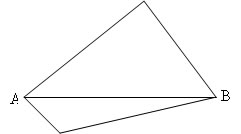
i = i1 + i2 + x - 2
p = p1 + p2 - 2x + 2. Now, I shall calculate F(P):
|
|
From the figure I observe that: i = i1 + i2 + x - 2 p = p1 + p2 - 2x + 2. Now, I shall calculate F(P): |
|
|
|
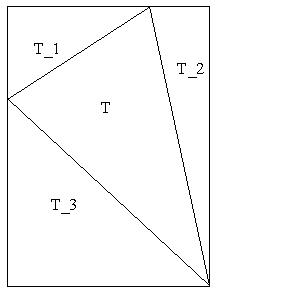 |
(4) Now I shall prove the theorem for
any triangle. Let T be a triangle. Any shape of
triangle can be enclosed in a rectangle
with edges parallel to the coordinate
axes, as in the diagram, by adding at
most three triangles. From part (1):
|