On the
twelfth day of Christmas, my true love gave to me..
.
How many gifts?
But that's easy; all you have to do is add up the numbers from
one to twelve.
That sounds easy, but what if the last line had been...
fifty
drummers drumming ?
Isn't there a better way than huddling over your
calculator?
And a
partridge in a pear tree...
On the fifth day
gifts are given.
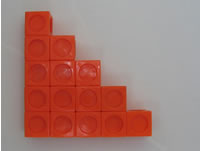
We can visualize this as
squares arranged
into the shape of a staircase;
square on
top of
squares on top of
squares etc.
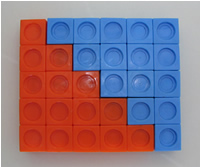
Two of these staircases can be placed together to form a
rectangle. The stair shape is half the area of the rectangle,
which is:
For the twelfth day we can repeat the process and end up
with a new rectangle, as shown on the right. The
rectangle is
by
. We can now say:
|
|
So the true love gets
gifts on the twelfth day of Christmas.
How many gifts arrive on the
th day?
The same argument applies and we would end up drawing a rectangle
that was
squares high and
squares wide. We would end up with:
Four
turtle doves...
That's all well and good but what if the true love went overboard on the
whole gift front? Instead of two turtle doves, he gave four; instead of three French hens he gave nine ... More precisely, if instead of giving
gifts on the
th day,
(normally written as
) gifts are given, then what?
Now on the twelfth day there would be
gifts.
Is it time to huddle over our calculator now?
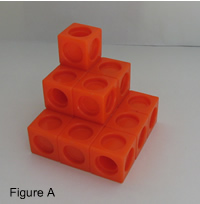
Not quite yet, we can visualize the number of
gifts on the third day, for example as
cube
on top of
cubes on top of
cubes arranged
as in Figure A.
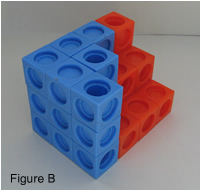
Now treat the object in A as a single building block. If you put
two of these building blocks together you get the solid in Figure
B.
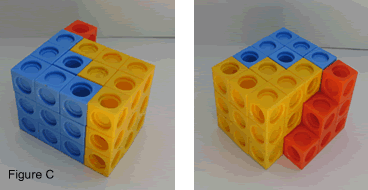
Adding another building block you get the solid on the left in
Figure C. The picture on the right is just a different view of
the solid shown on the left.
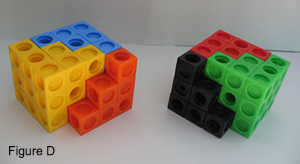
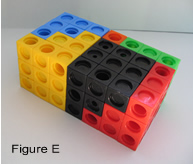
Figures D and E show two copies of the solid made from three
building blocks separately (D) and then placed together
(E).
Now what is the point of all this? Well the task is to work out how many cubes are inside our building block, we
can do it two ways. By direct counting we get:
.
But we also have shown that six of our building blocks can be arranged
into the solid cuboid in Figure E. So, how many cubes are there in Figure E?
Well the cuboid is
cubes high,
cubes wide and
cubes long
and the cuboid contains
of our building blocks. So the volume of our building block is:
Now here's a question: Would the construction have worked if our building block had more layers,
e.g.
cube on top of
cubes on top of
cubes on top of
cubes?
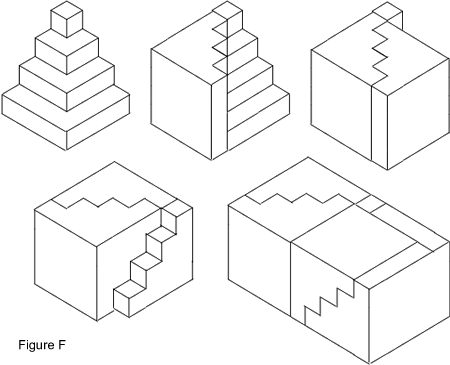
We can repeat the process, but this time starting with a block with four
layers. The final solid in Figure F is now a cuboid that is
cubes high,
cubes
wide
and
cubes long and the cuboid contains
of our building blocks. So in this case the volume of the building block is
|
|
By staring at the images, I hope you would agree that we can start with
a building block that has any number of layers and that following the same
construction we would end up with a cuboid that is
blocks high,
cubes wide and
cubes long and contains
our of building
blocks.
So then the volume of the building block would be
|
|
So our overzealous gift giver would have bestowed
gifts on his true love on the twelfth day.
Twenty-seven
French hens ...
You may now have an inkling as to where this is heading:
what if instead of two turtle doves, he gave eight
and three French hens became twenty-seven?
Demonstrations of the following result in this article can be
found but are not included here, for example you can look at
the problem "
Picture Story " .
|
|
A very pleasing result which means that ...
On the twelfth day our exhausted distributor of gifts would have dispensed:
|
|
Two hundred and fifty-six calling birds and more ...
So why stop there?
Well, if you are feeling a bit taxed and want to stop here, I
think I have given you enough to think about.
For the rest of you intrepid explorers who want to carry on to the
summit, for a whole number
and
..., go to the notes for more
and more and more....