In the first diagram the total turn for each motif is 330 degrees clockwise (or 30 degrees anti-clockwise). As 12×330=11×360 the path returns to the starting point after 12 repetitions of the motif and a total turn of 11 complete revolutions. The program is:

repeat 12 [fd 50 rt 40 fd 50 rt 130 fd 50 rt 160]

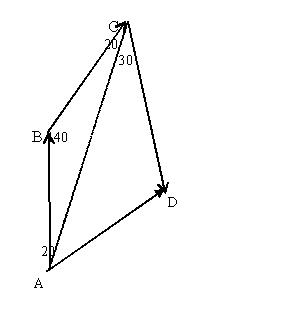
vector sum Adding the three vectors which make up a motif (e.g AB + BC + CD ) is a simple exercise in trigonometry.

The problem reduces to the same problem as in the Spirostars case because, joining the starting points of successive motifs A D gives line segments of constant length with a constant angle of turn of 30 degrees between each line segment. The pattern is a cycle of period 12.

In the second diagram the total turn for each motif is 450 degrees. As 4×450=5×360 the path returns to the starting point after 4 repetitions of the motif and a total turn of 5 revolutions. The program is:

repeat 4 [fd 100 rt 90 fd 10 rt 90 fd 20 rt 90 fd 50 rt 90 fd 25 rt 90 ]

In this case by joining the starting points of successive motifs we get line segments of constant length with a constant angle of turn of 90 degrees between each line segment. The pattern is a cycle of period 4.

In the third diagram the turn for each motif is 200 degrees. As 9×200=5×360 the path returns to the starting point after 9 repetitions of the motif and a total turn of 5 revolutions. The program is:

repeat 9 [fd 100 rt 120 fd 200 rt 80]

In the third case, by joining the starting points of successive motifs we get line segments of constant length with a constant angle of turn of 40 degrees between each line segment. The pattern is a cycle of period 9.
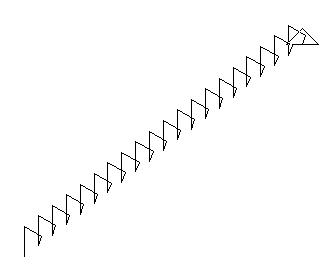
spiroflight In this case the vectors joining the starting points of successive motifs are all in the same direction so the motifs repeat themselves over and over again along a parallel strip.