This challenge extends other NRICH challenges which present the
same mathematical system for exploration in different ways by
different groups of learners:
'Round and round the circle',
Path to the stars' and
Stars. In the first and last of these you will find
interactivities for experimenting with these ideas. In Stars
there are downloadable pdfs so you can print out circles with
different numbers of equally spaced dots around the circles for
paper and pencil explorations.
Celia Hoyles once said that the best mathematical problems
challenge people of all ages by providing some questions that
everyone can answer, and aesthetically pleasing patterns that
everyone can appreciate, while at the same time leading to more
challenging questions and more general conjectures which require
sophisticated arguments and rigorous proofs.
|
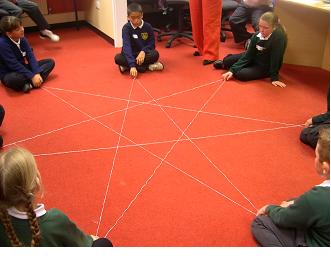
Lynne McClure introduced us to
the activity where, given enough
space and enough string, a whole
class can stand in a circle and
the string can be passed from one
person to another to form a star.
Suppose there are
people in
the circle and the string is passed
to the
th person around the circle
each time. This leads to many
questions about symmetry, about how
the stars are formed, about why the
activity sometimes produces regular
polygons, and about how many different
stars can be formed for a given
by varying
.
|
Variants of this activity are provided by using a circular
geoboard, or in
this interactivity which is a virtual geoboard, or by
drawing on a printed sheet with dots around the circumferences
of circles
All these activities presuppose that the points lie on a circle
and the angle of turn is a rational multiple of 360 degrees and
in this problem we make neither assumption.
This problem leads on to more general questions about
spirolaterals. In the question
Spiroflowers we consider what happens if the lengths of the
line segments in the path are varied and what happens if both
the lengths of the line segments and the angles of turn are
varied.