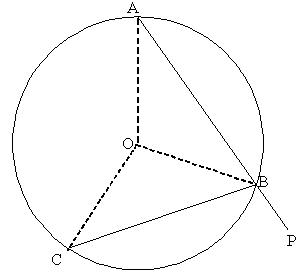
Draw the perpendicular bisectors of the line segments
and
,
then the intersection of the perpendicular bisectors is equidistant
from
,
and
and thus it is the centre of the circle with
and
as chords. All the perpendicular bisectors will meet
in a single point
equidistant from the endpoints of the line
segments. Therefore all the line segments are chords of a single
circle with centre
.
The angle of turn between the equal
chords
and
in the path
is
. Triangles
and
are isosceles
and
. Then (using
angles on a straight line and angles
in a triangle)
.
Consider radii drawn from the centre to the ends of
consecutive
chords in the path. The sum of angles between the radii is equal to
the total angle turn
so the path is closed if and only if
the total angle turn is an integer multiple of 360 degrees, that is
if and only if
or, equivalently
is a
rational multiple of 360 degrees.
We consider
where
and
are positive
integers and
. If the angle of turn is more than 360 degrees,
complete revolutions can be discounted, so effectively
produces the same path as
where
mod
.
If
is a factor of q, (say
) then the path is a regular
sided polygon because the total angle turned when
chords are
drawn is
degrees.
If
and
are not coprime then
for some integers
and
so that the total angle turn with s chords is
which is an integer multiple of 360 degrees so
the path is a star with
points. If
and
are coprime then
the path is a
pointed star.