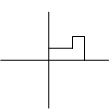
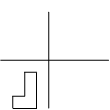
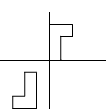
We received many correct solutions
describing each of the transformations. Well done Rahel from
Dartford Grammar School for Boys, Harry from Culford, Dominic,
Ellie, Finn and Max from Brenchley andMatfield Primary School,
Jannis from Long Bay, Ben from the Perse School and Emilio from
St Peter's College.
However, the second part caught almost
everyone out: since it looked like the first four transformations
were "undone" by their inverses, most people thought that the
string of transformations returned the original shape back to
where it started.
Only Emilio managed to work out that this was not the case:
From the first figure, it can be seen that
rotates the figure
clockwise round (0,0).
The second figure shows
then
.
Because
=
clockwise,
must equal
anticlockwise.
rotates the figure
anticlockwise and then
reflects it vertically.
Therefore
reflects the figure in the vertical axis.
The third figure has
then
.
The final figure finishes one square right after performing
.
Therefore
must translate the figure one square right.
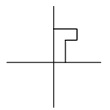
By doing
to the original
figure (fourth example), the shape ends up the same as the final
product of
and
.
Therefore
does nothing.
To solve the final part, we
need to work through each stage individually.
reflects the figure
vertically.
rotates it 90 degrees clockwise.
This leaves the
figure like this:
translates the figure 1 right:
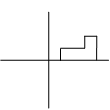
will do nothing.
reflects the figure again because
inverse reflections are the same as the original reflection.
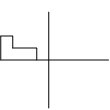
rotates the figure
anticlockwise:
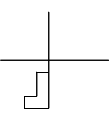
will translate the figure left one square.
does nothing, so
will do nothing.
Therefore a rotation of
round (-0.5, -0.5)
will have the same result as
Well done Emilio.
Editor's note:
would leave the original shape
unchanged since the inverse transformations would be applied in
the reverse order, "undoing" the last transformation first
(and the first one last). (If I put on my t-shirt and then put on my jumper, I "undo" this
by taking my jumper off first and then my t-shirt.)