(a) The two numbers must be of the form x and 2-x, where
x ³ 0 and 2-x ³ 0. The standard deviation is
s =
æ ú
Ö
(x-1)2 + (2-x-1)22
= |x-1|.
As 0 £ x £ 2 we see that s £ 1 and that we
have s = 1 when a=0 and b=2 (or a=2 and b=0).
(b)
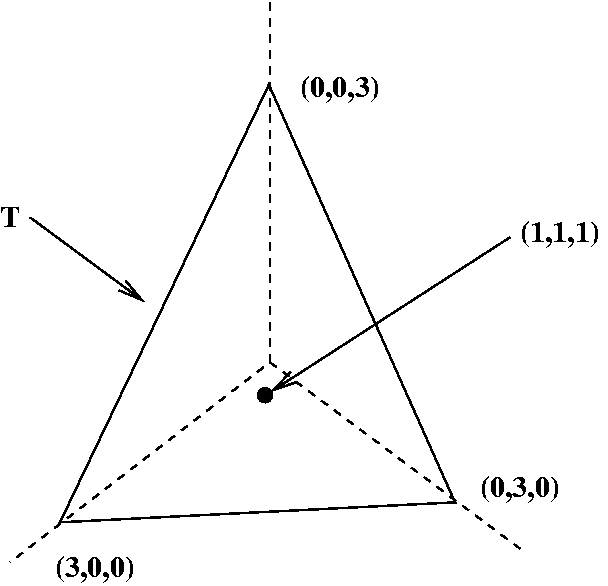
The three numbers x, y and z must satisfy x+y+z=3
(because their mean is 1). Thus the point (x,y,z) in 3-space
must lie on the plane x+y+z=3, and it is in the first octant of
3-space (as x and y and z are non-negative).
This means that (x,y,z) lies on the triangle T (in 3-space)
which has vertices (3,0,0), (0,3,0), (0,0,3). Note that
the point (1,1,1) is the centroid of T.
Now
s2 =
(x-1)2+(y-1)2+(z-1)23
,
and we want to maximize s or, equivalently, Ö3s,
which is the distance from (x,y,z) in T to the centroid
(1,1,1) of T. Clearly, this maximum occurs at each vertex; for
example at (x,y,z) = (3,0,0). Thus
s £
æ ú
Ö
(3-1)2+(0-1)2+(0-1)23
= Ö2.
(c)
If the n numbers are n,0,0,¼,0 (which have mean 1),
then the standard deviation is