 |
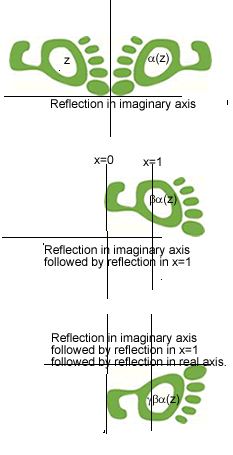
Consider the three reflections in the order
they are given, performed on the foot shape at
the far left. These three reflections give
a glide reflection
First the reflection
maps
to
.
This gives a reflection in the imaginary axis
resulting in a foot going toe-to-toe
with the original, above the x-axis, with big toe
near the origin, but pointing back in the
opposite
direction.
Now perform the reflection in the axis
given by
so that we have
maps
to
then to
.
This gives a foot pointing in the same direction
as our original and immediately in front of it.
Now do the reflection in the axis
y = 0 given by
so that the
three reflections map
to
then to
then to
You end with a foot below the x-axis, pointing
in the same direction as the original, with heel
2 units immediately in front of the toe of the
original giving a combination of translation and
reflection known as a glide reflection.
Repeating the reflections with the big toe of
the new foot becoming the new origin each time
gives the sequence of alternating feet walking
left-to-right.
|