Thank you to Lazarus from Colyton Grammar School and Andrei from
Tudor Vianu National College, Bucharest for your solutions to
this problem.We see that in all three cases the ratio XZ to XY is
the Golden Ratio.
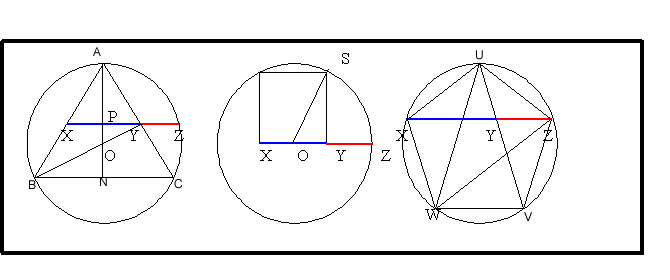
In the first diagram, taking the circle to have unit radius, AO = BO = CO = ZO.
Triangle BXO is similar to triangle XPO (angles 30o, 60o, 90o) so
and XO = BOsin30 = 1/2, OP = XOsin30 = 1/4 and
so
.
Now consider triangle OPZ. Angle OPZ = 90o. Therefore using
Pythagoras' Theorem,
. So
| XZ = XP + PZ = |
Ö3
4
|
(1 + Ö5)
|
and
which is the Golden Ratio.
In the second diagram, taking the side of the square XY as 1 unit
and using Pythagoras Theorem for triangle OSY gives
which is the radius of the circle. So
. Hence XZ = 1/2 (1 + Ö5) and
again the Golden Ratio.
In the third diagram take the sides of the pentagon to be 1 unit
long and the chords XZ and WZ etc. to be x units.
Triangles
UXY, YVZ and XZW are similar isosceles triangles (angles of
36o, 72o and 72o) with VY = VZ = XY = 1 and YZ = x-1. We
see that the ratio we want to find XZ/XY = x. By similar
triangles, taking the ratio of the long to the short sides, we get
which gives the quadratic equation
with solutions 1/2(1 + Ö5) or 1/2(1 - Ö5). The latter is negative so does not make sense geometrically so
the ratio must be the Golden Ratio: