Well done Shaun from Nottingham and Maria
from Seville.
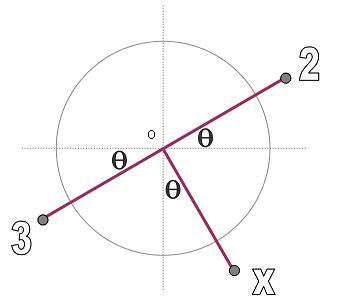
In this diagram $OX$ makes an angle $\theta$ with the vertical,
which means that the $2$ and $3$ weights both make an angle
$\theta$ with the horizontal.
If we take the length $OX$ as the unit and then think about a
vertical line through $O$ and the horizontal space between that
line and vertical lines through the $2$ and $3$ weights, and also
through $X$ .
We can see that the horizontal shift from the pivot for X is
$sin\theta$ and the horizontal shift from the pivot for the 2 and
for the 3 is $cos\theta$
The balance will come to a settled position so that:
$$3cos\theta$ = $2cos\theta$ + $Xsin\theta$$
which means that $Xsin\theta$ must equal $cos\theta$ or, after
a little rearranging,
$$ X = \frac{ cos\theta}{ sin\theta}$$
At Stage 4 this equation is properly best solved by trial and
improvement but if you have gone just a little bit further with
your maths, you may know that :
Investigate that if you haven't seen it
before .
So here tanq will equal 1/x, and all we need to do is find 1/x on a calculator and then take the inverse Tangent for that value.
In degrees the specific angles were 45 degrees and 26.6 degrees (to 1 decimal place)