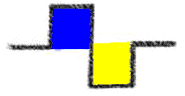
Jeremy of Drexel University and Andrei of Tudor Vianu National College, Bucharest, Romania sent in excellent solutions.The first half of this solution is Andrei's, the second Jeremy's.


To solve this problem, I made a table with the length and the area of the fractal at the first stages:

Stage Length Area
0 4 1
1 4×2=8 1
2 4× 22 =16 1

I have made the following observations:

The length of the fractal at each stage is
twice its length at the preceding stage.

The area of the fractal is constant because
the two colored areas are equal (the blue one
is added, the yellow one subtracted)

For the nth stage the length of the curve is
4x 2n = 2n+2 and the area is 1 square unit.


generator

Now we have the curve length for any stage n, and in turn, a stage n for any particular curve length.
1,000,000 = 2n+2 n = log2 (1,000,000)-2 n 17.9

Because 17<n<18, the length must have been less than 1,000,000 at stage 17 and greater than 1,000,000 at stage 18. Thus answers the question: stage 18. Further, we can now find the exact lengths of the curve at stage 17 and stage 18 to convince ourselves:
L(17)= 217+2 = 219 =524,288 which is less than 1,000,000
L(18)= 218+2 = 220 =1,048,576 which is greater than 1,000,000.

The length of the fractal is
limn 2n+2

and hence the fractal curve has infinite length. This is an example of a curve of infinite length surrounding a finite area.

What is the dimension of the fractal? Solution: d = 1.5
Explanation: the dimension d is given by the formula n= md .
n=8 because each segment is broken up into 8 self-similar segments.
m=4 because each of the 8 new segments is 1/4 the length of the original segment, and thus must be multiplied by 4 to be the length of the original segment.
So: 8= 4d and hence d= log4 8=1.5.