This article is a gentle introduction to differentiation, a tool that we shall
use to find gradients of graphs. It is intended for someone with no knowledge
of calculus, so should be accessible to a keen GCSE student or a student just
beginning an A-level course. There are a few exercises. Where you need the
answer for later parts of the article, solutions are provided, but you are
strongly encouraged to try the questions as you go: none of them is
particularly hard, and you will get a much better idea of what is going on if
you try things out for yourself. Use the solutions to check your answers,
rather than to avoid doing the questions!
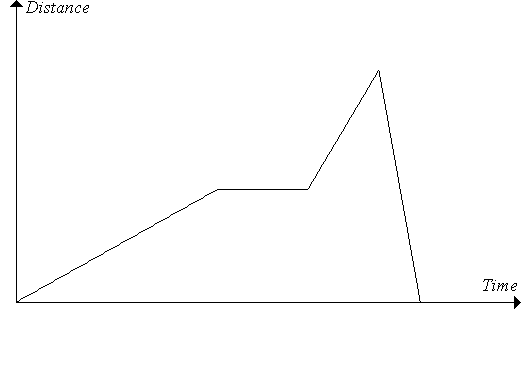
To work out how fast someone has travelled, knowing how far they went and how
long it took them, we work out
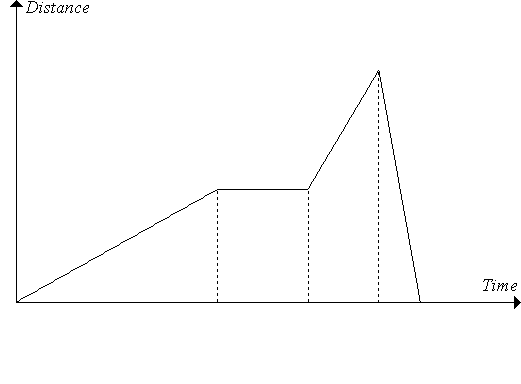
On a distance-time graph, this is equivalent to working out the gradient.
If the person was travelling at a constant speed, then the graph will be a
straight line, and so it's quite easy to work out the gradient. For example,
in the graph above we can work out the gradient of each straight line
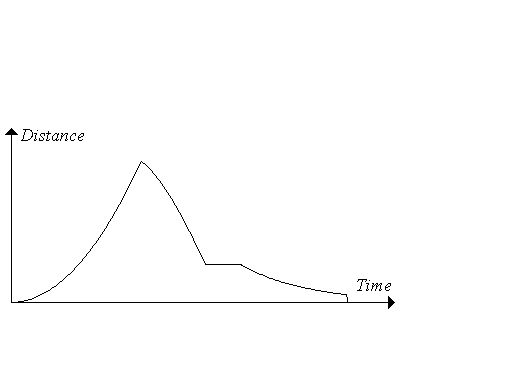
section. But what if they were travelling at varying speeds? Then the graph
will be a curve, and it's not quite so obvious how we can get the gradient.
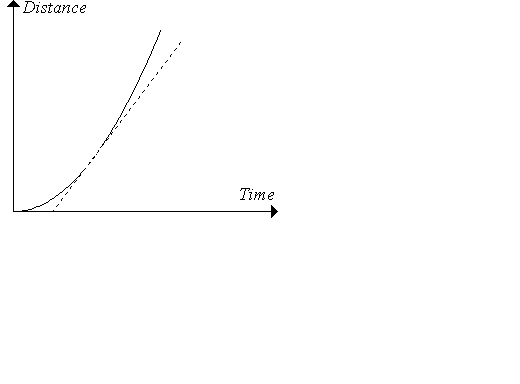
To find the gradient at a particular point, we need to work out the gradient
of the tangent to the graph at that point - that is, the gradient of
the straight line that just touches the graph there.
Note that a straight line has the same gradient all the way along, whereas a
curve has a varying gradient; we find the gradient at some specified point.
But actually trying to draw this tangent is both fiddly and inaccurate. What
would be really useful would be a more precise way of working out the gradient
of a curve at a particular point. We have such a formula when the curve is a
straight line: you may be used to the expression
"(change in
)/(change in
)''. But to do something similar for a curve,
we're going to need differentiation.
The idea of differentiation is that we draw lots of chords, that get closer
and closer to being the tangent at the point we really want. By considering
their gradients, we can see that they get closer and closer to the gradient
we want. Have a go with the following interactivity to see what I mean.
Do you agree that if we could work out the gradients of different chords as
they approximate the tangent better and better, and if they tend to a
limit, then we could work out the gradient of the tangent? By "tend to a
limit'', I mean that they get closer and closer, and in fact get as close as
we like. For example, suppose I had chords that got closer and closer to the
tangent, and their gradients were 1,
,
,
,
, .... Do you see that these are getting
closer and closer to 0, and no matter how close I want to get, I can find a
chord with a gradient that close? I'm deliberately being a little bit vague
here, because making this rigorous is quite hard (it comes up in the first
year of most university maths courses), but as long as you get the general
idea of what "tends to a limit'' means, that's fine for now.
Ok, so we've got the general principle. But can we actually use it? Let's
have a go with a fairly nice curve:
.
Exercise 1:
(i) Sketch the curve
- you'll need a nice, large graph for
the next part, so fill the piece of paper! You could find several points on
the curve and join them with a nice smooth curve, or perhaps you could use a
graphic calculator or graphing software on a computer (but you'll need a
printout for part (ii)).
(ii) Try to work out the gradient at some points, by drawing tangents
on your graph as well as you can. Try several different points, and see
whether you can spot a pattern.
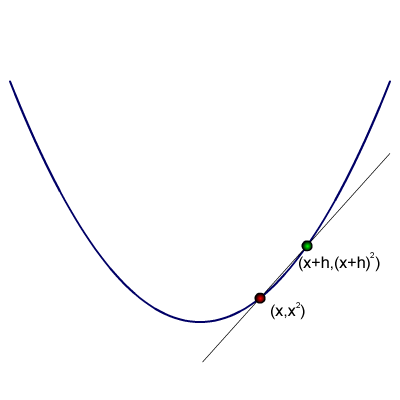
Let's be bold, and try to find the gradient at a general point
at
. To do this, we're going to need another point
at
. Remember the idea? We're going to find the
gradient of the chord between
and
, and then we're going to let
tend to 0 (that is, we'll move
closer and closer to
) and see whether
we can figure out the limit of the gradients.
What is the gradient of the chord
? Well, the chord is just a straight
line, so its gradient is (change in
)/(change in
). The change in
is easy: that's just
. What about the change in
? Well, the
-value
at
is
, and the
-value at
is
, so the change is
(multiply out the brackets yourself if
you're not sure about this!). So the gradient of the chord
is
. So far, so good. Now, as
tends to 0, can you see
that
is going to tend to
? So as we move
towards
, the
gradients of the chords tend to
, so the gradient of the curve at the
point
is
. And I never got my pencil and ruler out to actually
draw some tangents!
Exercise 2: How does this answer compare with your experimentation in
Exercise 1?
Now let's try a curve that's a little bit more complicated (but not much):
.
Exercise 3: Repeat Exercise 1, but this time using
. For this curve, our general point
is going to be
, and our
point
will be
. What's the gradient of
?
The change in
is just
, again.
Exercise 4: By multiplying out the brackets (or using the Binomial
Theorem, if you know about this), work out
.
This time the change in
is
. So the gradient of
is
. Now, what happens as
tends to
0? Well, certainly the
bit is going to tend to 0. (Are you happy with
this?) But also, so is the
bit - even if
is quite big, when
gets absolutely tiny,
is going to be pretty small. Try this with some
numbers if you don't believe me! So as
tends to 0, the gradient of
tends to
, so this is the gradient of
at
.
Exercise 5: Compare this answer with your experimentation in
Exercise 3.
Exercise 6: Work out
(I promise not to do any more of these,
but this one shouldn't be too bad!).
Exercise 7: Using the ideas from above and your answer to Exercise 6,
work out the gradient of
at
.
Exercise 8: Draw up a table like this one:
Gradient
Fill in the answers you've got so far. Can you spot a pattern? Can you guess
what the gradient's going to be for
?
You may by now have spotted that to do this more generally we're going to need
to work out
. To do this properly, we'd need the Binomial Theorem.
If you're interested, you can read about this on the
Maths Thesaurus. I'm not going to go into details about that now; instead,
we're going to cheat slightly (but I promise it does work really!). Hopefully
you worked out
and
earlier. Did you notice that we got
something of the form
?
(Yes, I know, "some other stuff'' isn't very mathematical, but that's where
we'd use the Binomial Theorem if we were being rigorous.) This time, our
point
is
, and our point
is
. Again,
the change in
is
, and when we work out the change in
, we're going
to get
. So when we
work out the gradient of
, we're going to have
. Now let's think about what happens as
tends to 0. Well, as we
hopefully agreed earlier,
times anything fixed is going to tend to 0 as
tends to 0, and whilst the (some other stuff) isn't actually fixed, the
only thing in it that changes is anything involving
, so that's just going
to get smaller too. So the gradient of
tends to
as
tends
to 0, so the gradient of
is
at
. Does this agree
with your guess in Exercise 8?
Exercise 9: Work out the gradients of
(i)
;
(ii)
;
(iii)
;
(iv)
where
is some fixed number;
(v)
;
(vi)
;
(vii)
.
Exercise 10: What would happen if we tried to work out the gradient
of
? Think carefully about what you'd get if you used the
technique above. Now can you work out the gradient of
without
really doing any work? (If you need to, start writing it all out, and see
whether you can spot how to make it easier.)
Exercise 11: What happens if you use our rule on a straight line
? Does this give the answer you'd expect? What about
, or
?
Exercise 12: (A little harder) Try using the technique we've used
above to work out the gradient of the chord
on the curve
,
and see whether you can work out the gradient of the curve at
. How
does this compare with the formula? (Note that
, so
you can substitute
into the formula above, although we haven't actually
proved that it should work, because we don't know what
is.)
This technique we've developed to find the gradient of a curve is called
differentiation. Hopefully you now understand how to differentiate
any polynomial. You don't have to do it from first principles each time:
once we've proved the basic results, we can just quote the fact that
differentiates to
and so on. It's possible to differentiate
other curves too; for example, we could find the gradient of the curves
(maybe you've already guessed how to do this),
,
or
. However, these require a little bit more technical machinery, so
we'll leave them for now.
As a quick aside, let's very briefly mention integration, as it's the
`other' part of calculus that comes up at A-level, although we shan't go into
any details here. Let's imagine a slightly different scenario: here, we know
how fast someone travelled, and how long for, and want to work out how far
they went. This time we use
(just rearranging the formula from above). This time, we could use a
speed-time graph and work out the area under the graph to find the distance.
If the lines surrounding the region are all straight, then this isn't too
hard - you've probably done questions like this that involve you having to
find the areas of triangles, rectangles and trapezia.
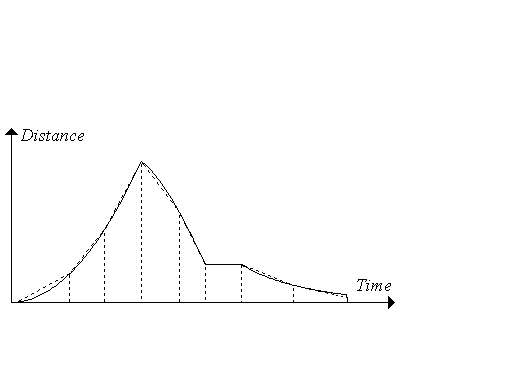
But what if the line is curved? You might have come across the idea of
approximating the area by roughly splitting it into triangles, rectangles,
and trapezia,
but this effectively means pretending that the curve is made up of several
straight sections, and this is never going to be precise. We can use
integration to find the area under the curve without this
approximation.
I've said that we use differentiation to find speed on a distance-time graph,
and integration on a speed-time graph. This sort of suggests that they're
related - a little bit like the link between addition and subtraction, where
we can use one to "undo'' the other. There is a theorem called the
Fundamental Theorem of Calculus (sounds impressive, doesn't it?!) that
explains this relationship more precisely, and that's why I wanted to mention
integration briefly too.
Differentiation (and calculus more generally) is a very important part of
mathematics, and comes up in all sorts of places, not only in mathematics but
also in physics (and the other sciences), engineering, economics, .... The
list goes on!