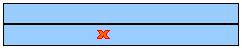
This problem is about an iterative process.
To iterate means to repeat, so an iterative process
involves repeating something many times.
Imagine some dough, Plasticine or Blu-Tack, something
that can be made into a strip then stretched.
We are going to take a length of this material, which
we'll regard as the unit length, and put a mark at some fraction
distance along it.
Now we are going to follow a procedure and see where
our mark ends up.
-
The material is folded in the middle so that the bottom
reaches back to the top.
-
The material is now only half a unit in length and twice
as fat, so it is rolled out or stretched uniformly to become
one unit in length again.
-
Finally we'll note the new position of our mark.
And that's the process we'll be repeating.
Now let's try with an actual fraction.
Starting for example at
First Iteration : We fold to get
then roll out, back to unit length
The new position is
Second Iteration : fold again
and roll back out to unit length
The position is now
Third Iteration : fold again
and roll back out to unit length
The position is now
for the second time But we know what happens after
, it goes to
, then
again, and so on for ever.
So what are you invited to investigate ?
- What happens for other start fractions ?
- Does everything go to a loop ?
- What size loops appear and for what fractions
?
In fact you'll want to describe those loops very carefully.
This problem came to our attention via an ATM workshop led by
Dave Hewitt, from the School of Education, University of
Birmingham.
We appreciate his permission to pass it on.




