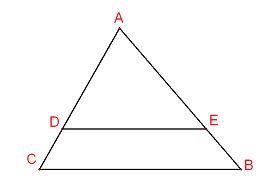
We are given a triangle ABC , and are required to draw a line DE parallel to CB such that it divides the triangle into 2 portions of equal areas.
The area of triangle ABC is double the area of AED.
But, ADE and ACB are similar triangles because DE is parallel to CB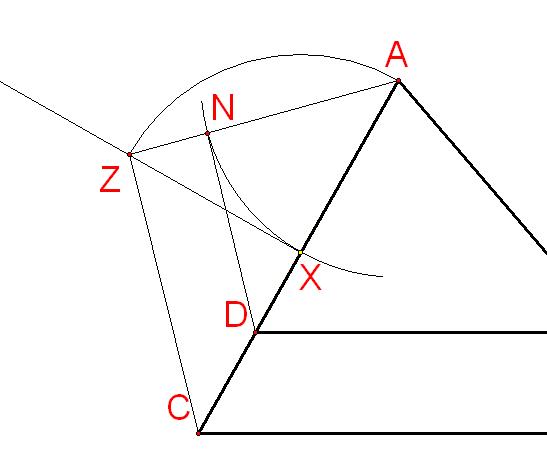
X is any suitable point on AD
ZX is perpendicular to AC, and ZX is equal in length to AX.
So AXZ is an isosceles right-angled triangle.
By sweeping an arc centre A from X to AZ at N, AN is made equal to AX
AN to AZ is now in the required ratio.
Drawing from N parallel to ZC the point D is reached.
Because AND and AZC are similar triangles, AD and AC are in the required ratio.
Excellent and simple!